Qué hace malo un prompt de video con IA y cómo arreglarlo
Descubre por qué fallan los prompts de video con IA cuando son vagos, están sobrecargados o mal cronometrados, y corrígelos con una lista práctica de director.
En la generación de video con IA hay un gran debate: ¿los prompts deben ser cortos o largos? Algunos defienden que lo mejor es un prompt corto porque deja espacio a la "imaginación" de la IA. Otros dicen que hay que agotar el límite de palabras con todo el detalle posible.
¿Y si te dijera que no es ni lo uno ni lo otro? Hay que encontrar el equilibrio justo, y el método de "talla única" sencillamente no funciona en todos los casos. Veamos por qué.
El peligro del prompt "demasiado corto"
Cuando digo corto, me refiero a una sola frase o menos.
Por ejemplo: "The cat is walking while the moon rises."
Es demasiado corto, incluso para una generación de 4 segundos, el clip más corto que produce Seedance 2.0. Le da a la IA demasiada libertad para hacer lo que quiera. Sin dirección, el modelo suele hacer lo mínimo y el resultado es un video de baja calidad, rígido o aleatorio.

El poder del prompt detallado "en su justa medida"
¿Qué pasa si lo ampliamos? Démosle a la IA indicaciones claras sobre el movimiento de cámara, la iluminación, el audio y el ritmo, hasta llevar el prompt a unos 2.000 caracteres.
Este es el prompt que usamos para el segundo video:
Visuals: Scene 1: A wide, sweeping cinematic shot of a silhouetted black cat with luminous emerald-green eyes walking slowly along the weathered wooden edge of a high rooftop. The sky behind it is a deep, velvety indigo gradient, transitioning from twilight to night. In the far distance, the jagged silhouette of a vast city skyline glimmers with thousands of tiny, distant electric lights. The camera moves with a slow, ultra-smooth horizontal tracking motion, perfectly matching the cat's steady, rhythmic, and incredibly graceful feline gait. Soft wisps of evening fog drift lazily through the lower third of the frame, adding depth and a mysterious atmosphere to the urban landscape. Scene 2: A sudden, dramatic cut to a tight, extreme close-up of the cat's paws softly pressing down on the damp, textured wood. Tiny droplets of evening dew glisten under the subtle ambient light. The camera angle is low, right at ground level, emphasizing the silent, calculated weight of each step. As the cat lifts one paw, a gentle lens flare catches a stray light beam. The focus is incredibly sharp, capturing the individual fine hairs around the cat's claws. Scene 3: The camera slowly tilts upward and pulls back into a breathtaking vertical composition. From behind the distant, shadowed mountains on the horizon, a colossal, hyper-detailed full moon begins its slow ascent. The intense, ethereal moonlight breaks through the scattered clouds, casting long, dramatic, and sharply defined shadows from the cat across the rooftop. The fur on the cat’s back catches the silver lunar light, creating a bright, glowing rim-light effect. Scene 4: Cut to a tight close-up of the cat's face. It pauses its walk, turning its head slowly toward the camera. Its brilliant green eyes reflect the perfect, round shape of the rising moon like twin mirrors. Its long white whiskers twitch subtly in the cool night breeze. Scene 5: A spectacular, high-angle crane shot that slowly moves upward and away from the roof. The cat resumes its steady walk, moving toward the very corner of the building, completely framed within the massive, glowing circle of the fully risen moon. The scale contrast is immense, making the cat look like a tiny, mythical guardian of the night.
Audio & Dialogue:The soundscape begins with a deeply atmospheric, low-frequency ambient synth drone that evokes a sense of cosmic scale and quiet mystery. Underneath the drone, the subtle, realistic sounds of the night are present. As the moon begins to rise in Scene 3, a beautiful, minimalist orchestral score enters. A single, hauntingly elegant cello melody plays a slow, ascending minor progression. When the cat blinks in Scene 4, the music softens, leaving only a pure, resonant piano chord that lingers in the air.
¿Ves cuánto mejor fluye? Es increíblemente cinematográfico. Y si no buscas un look cinematográfico, ¡no pasa nada! Puedes ajustar los detalles a un estilo de vlog casual, de anime, etc. Lo importante es que el control lo tienes tú.
El problema de la sobrecarga: demasiado detalle + timestamps
Hablemos ahora del otro extremo. Otro problema importante aparece cuando intentas meter a la fuerza timestamps junto a enormes bloques de texto descriptivo.
Si metes demasiada acción, diálogos complejos y timestamps que lo controlan todo en un solo prompt, provocas una "sobrecarga de información". El modelo simplemente no puede procesar tantos datos cambiantes dentro del límite estricto de 15 segundos por generación de Seedance 2.0.
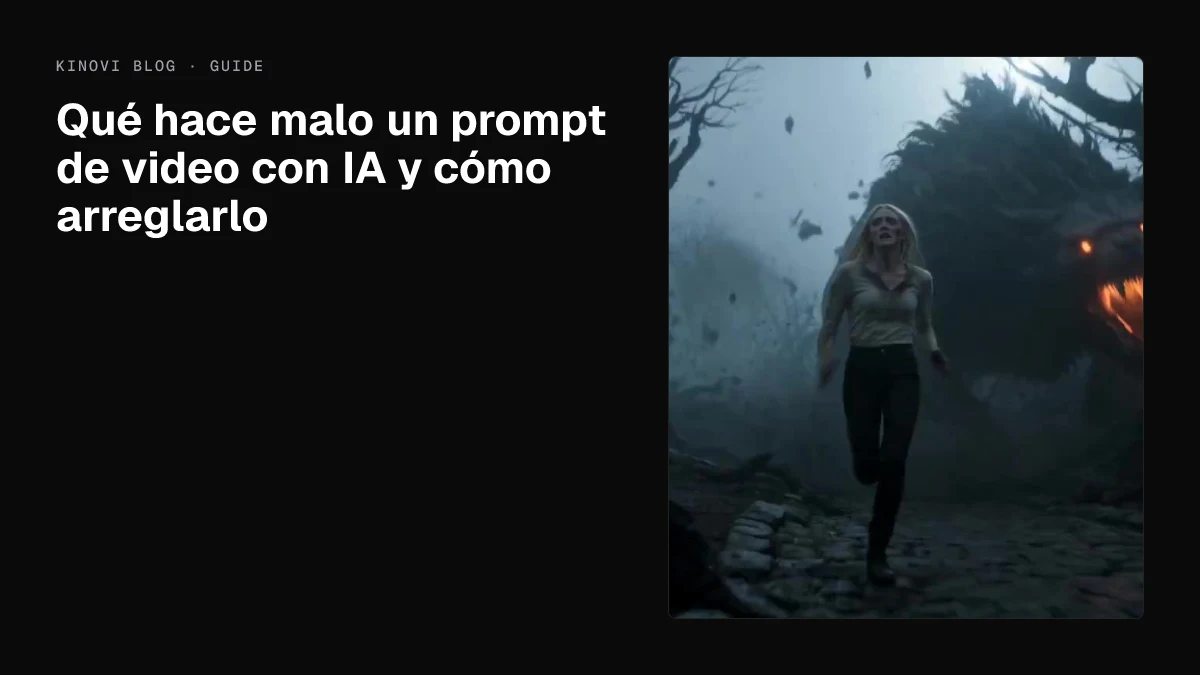
Veamos este prompt extremadamente denso, en el que una mujer huye de un perro demoníaco gigante, dividido en intervalos estrictos de 5 segundos:
The blonde woman is a fragile, desperate figure, sprinting wildly over sharp, broken cobblestones and twisted roots, fleeing through a desolate, decaying, fog-drenched gothic landscape. She is being hunted relentlessly by an unfathomably vicious 10-foot demon dog, a hulking, unstoppable mass of scarred, obsidian-black muscle, bristling fur, and infernal energy. The horrifying scale is constantly emphasized by the beast’s massive, boulder-sized paws that shatter the frozen ground and splinter ancient fallen trees with terrifying ease. Its jagged, molten-glowing jaws are large enough to snap a carriage in half, towering menacingly over her delicate, exhausted human frame as it gains ground.
The blonde woman is the primary focus for human desperation, her face caked in mud, blood, and sweat. Reference @Audio1 for her breathless, terrified voice, intercut with the deafening, bone-rattling guttural roars of the abyssal hound.
00:00-00:05 - The blonde woman sprints frantically into frame. Fast-paced, kinetic handheld tracking shot, staying incredibly tight on her desperate movements as she weaves through a dead, jagged forest. Behind her, out of the thick, oppressive mist, the 10-foot demon dog explodes through the dense treeline, instantly turning massive, centuries-old oaks into flying splinters. The beast snarls, its breathing sounding like a roaring furnace, thick, viscous saliva slinging from its monstrous, razor-filled maw. The ground violently shakes with every thundering, galloping impact of the creature, kicking up massive chunks of dark earth and debris in its wake.
00:05-00:10 - Cut to a tight, high-speed frontal tracking shot of the blonde woman’s face, isolating her in the frame. Pure, unadulterated terror is etched into every muscle of her features; her chest heaves violently, her blonde hair matted to her skin with sweat and freezing rain. She risks a panicked, agonizing glance over her shoulder, witnessing the molten-eyed monstrosity lunging dangerously close, the extreme heat of its breath visibly distorting the freezing air just inches behind her. Her voice cracks with absolute desperation, breathless, weeping, and shattered, as she screams out: "No! Please, God, somebody help me! Get back! Leave me alone!" Her tone is completely stripped of hope, raw, horrified, and driven purely by primal survival instinct.
00:10-00:15 - Most of the camera shots suddenly drop to extremely low, ground-level Dutch angles, focusing entirely on the sheer, unstoppable momentum and devastating power of the demon dog’s thundering, muscular legs. The beast’s gargantuan, heavily clawed paws rip deep, violent trenches into the muddy earth with every terrifying stride. A suffocating sense of nightmare-inducing dread dominates the atmosphere as the monster ruthlessly bounds over shattered stone ruins and decaying terrain. The final shots should capture the immense, inescapable weight and velocity of the creature's final bounding leap toward the camera, its colossal, horrific shadow completely swallowing the stumbling blonde woman in utter darkness.
Keep consistent size references: the demon dog's shoulder height is a towering 10 feet, its massive, hulking bulk easily dwarfing the blonde woman. The dog's crushing paws are the size of large boulders, and its jaws are wide enough to easily engulf a human torso.
Ridley Scott and Guillermo del Toro inspired cinematography. High-contrast chiaroscuro lighting, deep, suffocating shadows, and cold, desaturated colors. 6500K color temperature for the piercing, eerie moonlight slicing through the canopy, sharply juxtaposed by the aggressive 2000K hellish, fiery glow radiating from the hound's eyes and throat. Heavy, rolling ground fog, cinematic survival-horror realism, visceral kinetic camera shake, and a constant, pulse-pounding feeling of inescapable terror from every angle. Big-budget dark fantasy monster-movie tone with grim, hyper-realistic detail.
Audio & Dialogue:
The blonde woman's breathless, terrified voice, intercut with the deafening, bone-rattling guttural roars of the abyssal hound. The beast snarls, its breathing sounding like a roaring furnace, thick, viscous saliva slinging from its monstrous, razor-filled maw. The blonde woman's voice cracks with absolute desperation, breathless, weeping, and shattered, as she screams out: "No! Please, God, somebody help me! Get back! Leave me alone!" Her tone is completely stripped of hope, raw, horrified, and driven purely by primal survival instinct.
El resultado: como ves en la generación, cuando la IA se sobrecarga aparecen alucinaciones. A veces la física se rompe, la escala se deforma o el diálogo se omite por completo (aunque, por suerte, eso no ocurrió en esta demo).
No te digo que nunca puedas usar timestamps. ¡Claro que puedes! Pero cuando tratas cada timestamp como una escena independiente dentro de un mismo prompt, aumentas muchísimo la probabilidad de alucinaciones visuales y errores de audio.
La trampa del límite de caracteres y la regla de los 10 segundos
Muchos creadores ven el límite máximo de caracteres del prompt y piensan: "Tengo que usar hasta la última palabra para sacarle partido a mi dinero". En realidad, agotar el límite de caracteres es muy poco recomendable. Más palabras no equivalen automáticamente a un mejor video; de hecho, darle a la IA un muro de texto es la forma más rápida de provocar errores. Cuando sobrecargas el prompt, el modelo tiene que hacer malabares con demasiadas instrucciones a la vez, y el resultado son órdenes ignoradas, física deformada y alucinaciones visuales.
Este problema se agrava mucho según la duración de la generación.
El umbral de los 10 segundos:
Aunque Seedance 2.0 te permite generar hasta 15 segundos (Seedance 2.5 llega a 30), superar la marca de los 10 segundos aumenta de por sí la tendencia a los errores.
-
Las generaciones de menos de 10 segundos son compactas, controladas y muy fieles a tu prompt. Así el modelo maneja mucho mejor las escenas de acción intensa.
-
Las generaciones de más de 10 segundos obligan a la IA a mantener física compleja, iluminación y consistencia de personajes durante mucho más tiempo. Te recomiendo pasar de 10 segundos si la escena es sencilla. Recuerda que es solo una recomendación: puedes lograr que funcione con 15 segundos, pero la probabilidad de errores será mayor.
Si combinas un prompt al límite y con exceso de detalle con una generación de 15 segundos, casi te garantizas un alto riesgo de que el video se descomponga, pierda consistencia temporal o ignore por completo tu diálogo hacia el final del clip.
La conclusión: centra tus prompts en los detalles esenciales de la escena inmediata y, si quieres acción intensa y compleja, ¡mantén la generación por debajo de 10 segundos!
La solución del director
¿Mi mejor consejo para escenas complejas con varios planos? Haz de cada timestamp su propia generación de video y luego únelas, o usa una referencia de video para extender el video con el prompt sencillo "Continue film after @Video1 . (Then add your own details here) "
Para patrones de producción reutilizables, consulta 24 ejemplos de prompts para Seedance 2.5.
Una última revisión del prompt
Antes de enviarlo, confirma que el prompt tiene un sujeto claro, una acción principal, una indicación de cámara fácil de entender, una duración realista, reglas explícitas para conservar las referencias y un último fotograma aprovechable. Divide una idea compleja de varios planos en tareas separadas en lugar de forzar todas las escenas en una sola generación.
Fuentes consultadas
Última revisión: 24 de septiembre de 2026.
Artículos relacionados
More to try
Modelos relacionados
ByteDance · video model
Seedance 2.0
Modelo de video con IA de próxima generación de ByteDance. Combina los modos Fast y Pro para generar videos de alta calidad.
$0.0707/s
Alibaba · video model
HappyHorse 1.0
HappyHorse 1.0 es el modelo de generación de video de alta calidad de Alibaba disponible en Kinovi. Admite texto a video, imagen a video, video con imágenes de referencia y edición de video.
$0.0801/s
OpenAI · image model
GPT Image 2
Modelo avanzado de generación y edición de imágenes con IA de OpenAI. Comprende conceptos complejos y genera imágenes detalladas y realistas a partir de texto.
$0.0100/image