Ce qui fait un mauvais prompt vidéo IA, et comment le corriger
Découvrez pourquoi les prompts vidéo IA échouent quand ils sont trop vagues, surchargés ou mal calibrés, puis corrigez-les avec une checklist de réalisateur.
En génération vidéo par IA, un grand débat fait rage : faut-il des prompts courts ou longs ? Certains affirment qu'un prompt court est préférable, parce qu'il laisse de la place à « l'imagination » de l'IA. D'autres conseillent de remplir la limite de mots avec un maximum de détails.
Et si je vous disais que ce n'est ni l'un ni l'autre ? Il faut trouver le juste équilibre, et la méthode « taille unique » ne fonctionne tout simplement pas partout. Voyons pourquoi.
Le danger du prompt « trop court »
Par court, j'entends une seule phrase, voire moins.
Prenez cet exemple : "The cat is walking while the moon rises."
C'est beaucoup trop court, même pour une génération de 4 secondes, la durée minimale de Seedance 2.0. Cela laisse à l'IA bien trop de liberté pour faire ce qu'elle veut. Sans direction, le modèle se contente souvent du strict minimum, et la vidéo paraît de mauvaise qualité, figée ou aléatoire.
La force du prompt détaillé « juste comme il faut »
Que se passe-t-il si on l'étoffe ? Donnons à l'IA des indications claires sur le mouvement de caméra, la lumière, l'audio et le rythme, pour arriver à un prompt d'environ 2 000 caractères.
Voici le prompt utilisé pour la seconde vidéo :
Visuals: Scene 1: A wide, sweeping cinematic shot of a silhouetted black cat with luminous emerald-green eyes walking slowly along the weathered wooden edge of a high rooftop. The sky behind it is a deep, velvety indigo gradient, transitioning from twilight to night. In the far distance, the jagged silhouette of a vast city skyline glimmers with thousands of tiny, distant electric lights. The camera moves with a slow, ultra-smooth horizontal tracking motion, perfectly matching the cat's steady, rhythmic, and incredibly graceful feline gait. Soft wisps of evening fog drift lazily through the lower third of the frame, adding depth and a mysterious atmosphere to the urban landscape. Scene 2: A sudden, dramatic cut to a tight, extreme close-up of the cat's paws softly pressing down on the damp, textured wood. Tiny droplets of evening dew glisten under the subtle ambient light. The camera angle is low, right at ground level, emphasizing the silent, calculated weight of each step. As the cat lifts one paw, a gentle lens flare catches a stray light beam. The focus is incredibly sharp, capturing the individual fine hairs around the cat's claws. Scene 3: The camera slowly tilts upward and pulls back into a breathtaking vertical composition. From behind the distant, shadowed mountains on the horizon, a colossal, hyper-detailed full moon begins its slow ascent. The intense, ethereal moonlight breaks through the scattered clouds, casting long, dramatic, and sharply defined shadows from the cat across the rooftop. The fur on the cat’s back catches the silver lunar light, creating a bright, glowing rim-light effect. Scene 4: Cut to a tight close-up of the cat's face. It pauses its walk, turning its head slowly toward the camera. Its brilliant green eyes reflect the perfect, round shape of the rising moon like twin mirrors. Its long white whiskers twitch subtly in the cool night breeze. Scene 5: A spectacular, high-angle crane shot that slowly moves upward and away from the roof. The cat resumes its steady walk, moving toward the very corner of the building, completely framed within the massive, glowing circle of the fully risen moon. The scale contrast is immense, making the cat look like a tiny, mythical guardian of the night.
Audio & Dialogue:The soundscape begins with a deeply atmospheric, low-frequency ambient synth drone that evokes a sense of cosmic scale and quiet mystery. Underneath the drone, the subtle, realistic sounds of the night are present. As the moon begins to rise in Scene 3, a beautiful, minimalist orchestral score enters. A single, hauntingly elegant cello melody plays a slow, ascending minor progression. When the cat blinks in Scene 4, the music softens, leaving only a pure, resonant piano chord that lingers in the air.
Vous voyez comme tout s'enchaîne mieux ? C'est incroyablement cinématographique. Et si vous ne cherchez pas un rendu cinéma, aucun problème ! Ajustez les détails pour un style vlog décontracté, un style anime, etc. L'essentiel, c'est que vous gardez le contrôle.
Le problème de la surcharge : trop de détails + timestamps
Parlons maintenant de l'autre extrême. Un autre gros problème survient quand vous essayez d'imposer des timestamps au milieu d'énormes blocs de texte descriptif.
Si vous entassez trop d'action, des dialogues complexes et des timestamps qui contrôlent tout dans un seul prompt, vous provoquez une « surcharge d'information ». Le modèle ne peut tout simplement pas traiter autant de données changeantes dans la limite stricte de 15 secondes par génération de Seedance 2.0.
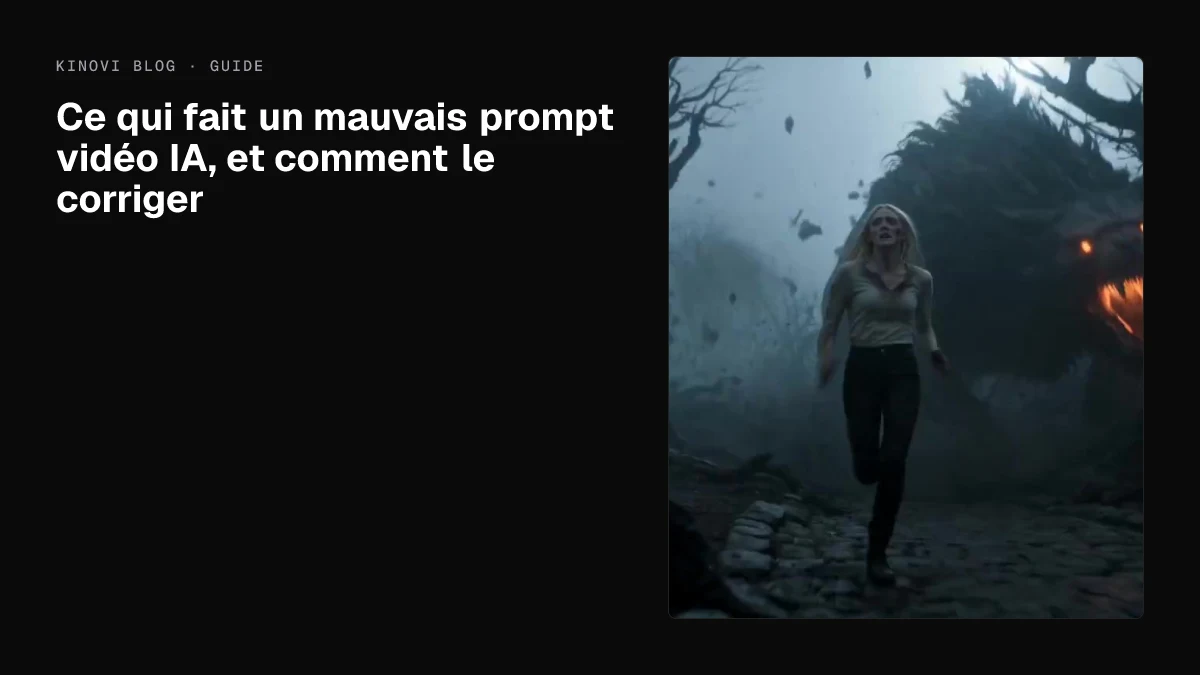
Regardons ce prompt extrêmement dense, où une femme fuit un chien démoniaque géant, découpé en intervalles stricts de 5 secondes :
The blonde woman is a fragile, desperate figure, sprinting wildly over sharp, broken cobblestones and twisted roots, fleeing through a desolate, decaying, fog-drenched gothic landscape. She is being hunted relentlessly by an unfathomably vicious 10-foot demon dog, a hulking, unstoppable mass of scarred, obsidian-black muscle, bristling fur, and infernal energy. The horrifying scale is constantly emphasized by the beast’s massive, boulder-sized paws that shatter the frozen ground and splinter ancient fallen trees with terrifying ease. Its jagged, molten-glowing jaws are large enough to snap a carriage in half, towering menacingly over her delicate, exhausted human frame as it gains ground.
The blonde woman is the primary focus for human desperation, her face caked in mud, blood, and sweat. Reference @Audio1 for her breathless, terrified voice, intercut with the deafening, bone-rattling guttural roars of the abyssal hound.
00:00-00:05 - The blonde woman sprints frantically into frame. Fast-paced, kinetic handheld tracking shot, staying incredibly tight on her desperate movements as she weaves through a dead, jagged forest. Behind her, out of the thick, oppressive mist, the 10-foot demon dog explodes through the dense treeline, instantly turning massive, centuries-old oaks into flying splinters. The beast snarls, its breathing sounding like a roaring furnace, thick, viscous saliva slinging from its monstrous, razor-filled maw. The ground violently shakes with every thundering, galloping impact of the creature, kicking up massive chunks of dark earth and debris in its wake.
00:05-00:10 - Cut to a tight, high-speed frontal tracking shot of the blonde woman’s face, isolating her in the frame. Pure, unadulterated terror is etched into every muscle of her features; her chest heaves violently, her blonde hair matted to her skin with sweat and freezing rain. She risks a panicked, agonizing glance over her shoulder, witnessing the molten-eyed monstrosity lunging dangerously close, the extreme heat of its breath visibly distorting the freezing air just inches behind her. Her voice cracks with absolute desperation, breathless, weeping, and shattered, as she screams out: "No! Please, God, somebody help me! Get back! Leave me alone!" Her tone is completely stripped of hope, raw, horrified, and driven purely by primal survival instinct.
00:10-00:15 - Most of the camera shots suddenly drop to extremely low, ground-level Dutch angles, focusing entirely on the sheer, unstoppable momentum and devastating power of the demon dog’s thundering, muscular legs. The beast’s gargantuan, heavily clawed paws rip deep, violent trenches into the muddy earth with every terrifying stride. A suffocating sense of nightmare-inducing dread dominates the atmosphere as the monster ruthlessly bounds over shattered stone ruins and decaying terrain. The final shots should capture the immense, inescapable weight and velocity of the creature's final bounding leap toward the camera, its colossal, horrific shadow completely swallowing the stumbling blonde woman in utter darkness.
Keep consistent size references: the demon dog's shoulder height is a towering 10 feet, its massive, hulking bulk easily dwarfing the blonde woman. The dog's crushing paws are the size of large boulders, and its jaws are wide enough to easily engulf a human torso.
Ridley Scott and Guillermo del Toro inspired cinematography. High-contrast chiaroscuro lighting, deep, suffocating shadows, and cold, desaturated colors. 6500K color temperature for the piercing, eerie moonlight slicing through the canopy, sharply juxtaposed by the aggressive 2000K hellish, fiery glow radiating from the hound's eyes and throat. Heavy, rolling ground fog, cinematic survival-horror realism, visceral kinetic camera shake, and a constant, pulse-pounding feeling of inescapable terror from every angle. Big-budget dark fantasy monster-movie tone with grim, hyper-realistic detail.
Audio & Dialogue:
The blonde woman's breathless, terrified voice, intercut with the deafening, bone-rattling guttural roars of the abyssal hound. The beast snarls, its breathing sounding like a roaring furnace, thick, viscous saliva slinging from its monstrous, razor-filled maw. The blonde woman's voice cracks with absolute desperation, breathless, weeping, and shattered, as she screams out: "No! Please, God, somebody help me! Get back! Leave me alone!" Her tone is completely stripped of hope, raw, horrified, and driven purely by primal survival instinct.
Le résultat : comme vous le voyez dans la génération, quand l'IA est surchargée, les hallucinations apparaissent. Parfois la physique se casse, l'échelle se déforme, ou des dialogues sont carrément sautés (même si, par chance, cela ne s'est pas produit dans cette démo).
Je ne dis pas qu'il ne faut jamais utiliser de timestamps. Vous pouvez ! Mais quand vous traitez chaque timestamp comme une scène autonome au sein d'un même prompt, vous augmentez considérablement le risque d'hallucinations visuelles et d'erreurs audio.
Le piège de la limite de caractères et la règle des 10 secondes
Beaucoup de créateurs voient la limite maximale de caractères du prompt et se disent : « Je dois utiliser chaque mot pour en avoir pour mon argent. » En réalité, saturer la limite de caractères est fortement déconseillé. Plus de mots ne donnent pas automatiquement une meilleure vidéo ; au contraire, servir à l'IA un énorme pavé de texte est le moyen le plus rapide de provoquer des erreurs. Quand vous surchargez le prompt, le modèle doit jongler avec trop d'instructions à la fois, ce qui entraîne des consignes ignorées, une physique déformée et des hallucinations visuelles.
Le problème s'amplifie fortement avec la durée de génération.
Le seuil des 10 secondes :
Seedance 2.0 permet de générer jusqu'à 15 secondes (Seedance 2.5 monte jusqu'à 30), mais dépasser la barre des 10 secondes augmente par nature la tendance aux erreurs.
-
Les générations de moins de 10 secondes sont serrées, maîtrisées et très fidèles à votre prompt. Le modèle gère bien mieux les scènes d'action intenses dans ce format.
-
Les générations de plus de 10 secondes obligent l'IA à maintenir une physique, un éclairage et une cohérence de personnages complexes sur une durée bien plus longue. Je vous recommande de dépasser 10 secondes si la scène est simple. Rappel : ce n'est qu'une recommandation ; vous pouvez réussir un clip de 15 secondes, mais le risque d'erreurs sera plus élevé.
Si vous combinez un prompt saturé et surchargé de détails avec une demande de génération de 15 secondes, vous êtes presque assuré que la vidéo risque fortement de se dégrader, de perdre sa cohérence temporelle ou d'ignorer complètement vos dialogues avant la fin du clip.
À retenir : concentrez vos prompts sur les détails essentiels de la scène immédiate et, pour une action lourde et complexe, restez sous les 10 secondes de génération !
La solution du réalisateur
Mon meilleur conseil pour les scènes complexes à plusieurs plans ? Faites de chaque timestamp sa propre génération vidéo, puis assemblez-les au montage, ou utilisez une référence vidéo pour prolonger la vidéo avec le simple prompt "Continue film after @Video1 . (Then add your own details here) "
Pour des modèles de production réutilisables, consultez 24 exemples de prompts pour Seedance 2.5.
Une dernière vérification du prompt
Avant d'envoyer, vérifiez que le prompt comporte un sujet clair, une action principale, une indication de caméra lisible, une durée réaliste, des règles explicites de préservation des références et une dernière image exploitable. Découpez une idée complexe à plusieurs plans en tâches séparées plutôt que de forcer toutes les scènes dans une seule génération.
Sources vérifiées
Dernière vérification : 24 septembre 2026.
Articles associés
More to try
Modèles associés
ByteDance · video model
Seedance 2.0
Modèle vidéo IA de nouvelle génération par ByteDance. Combine les modes Fast et Pro pour générer des vidéos de haute qualité.
$0.0707/s
OpenAI · image model
GPT Image 2
Modèle avancé de génération et d'édition d'images IA par OpenAI. Comprend les concepts complexes et génère des images détaillées et réalistes à partir de texte.
$0.0100/image
Midjourney · image model
Midjourney V8
Le dernier modèle Midjourney avec une qualité photoréaliste et un contrôle créatif.
$0.0565/4 images