Higgsfield API Alternative (2026): Pricing vs Kinovi & Migration Guide
Compare Higgsfield API vs Kinovi (Nov 2026): Seedance 2.5 Edit up to 50% lower, Kling 4.0 at parity, non-expiring credits, 30-day retention & migration code.
If you are evaluating a Higgsfield API alternative, compare the exact per-second rate on your workload alongside three structural billing differences: credit expiry, wallet separation, and API schema design. Audited on 20 November 2026, Kinovi cuts Seedance 2.5 Edit and Extend costs by 46.9% to 49.8%, matches Higgsfield on Kling 4.0 (<1% difference) and Seedance 2.5 text-to-video (<3% difference), undercuts Higgsfield on Seedream 5.0 Pro, unifies every model behind one createTask / recordInfo AI video generation API envelope, retains generated files for 30 days (vs 7 days), and shares one non-expiring credit balance across Studio and the API.
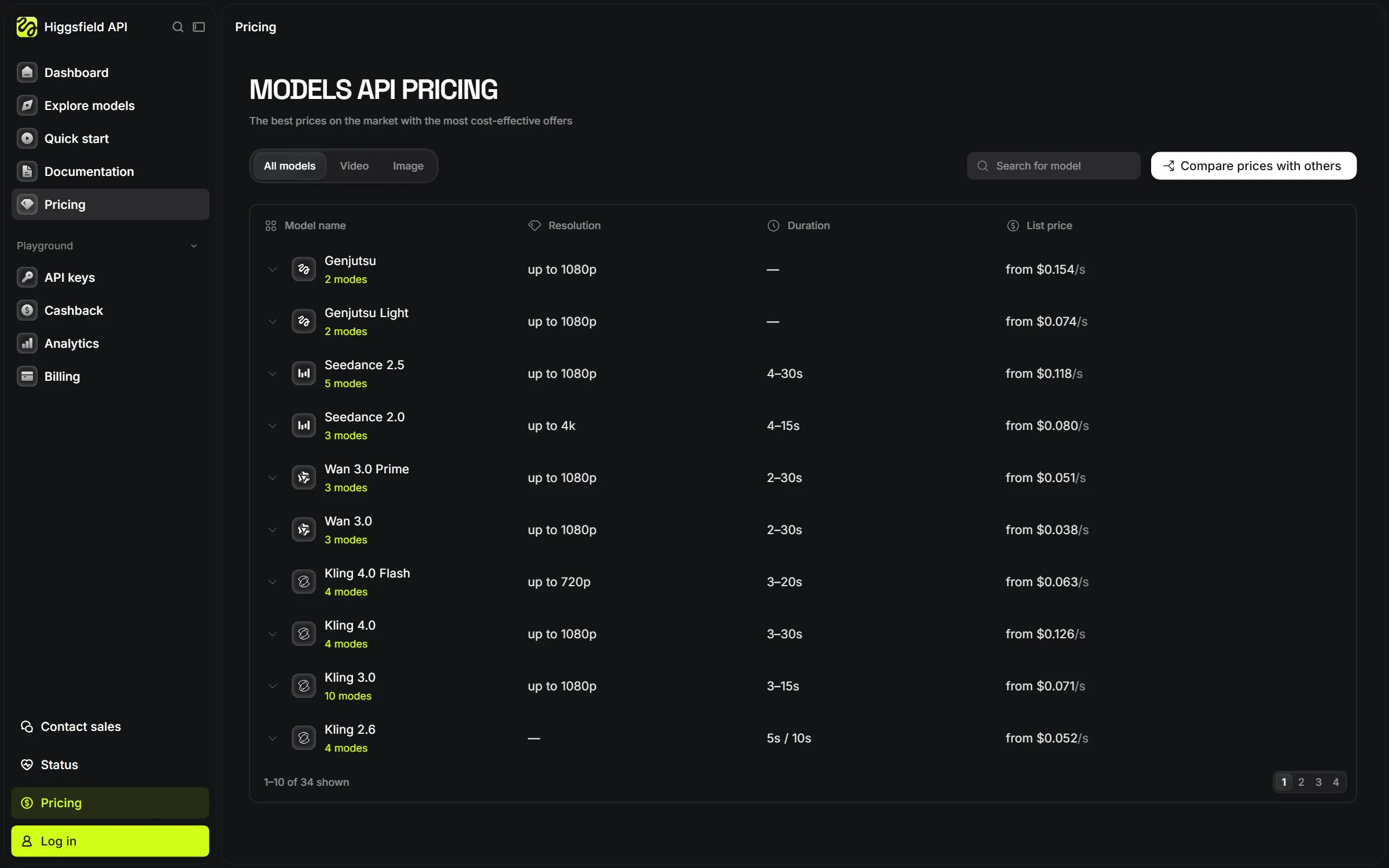
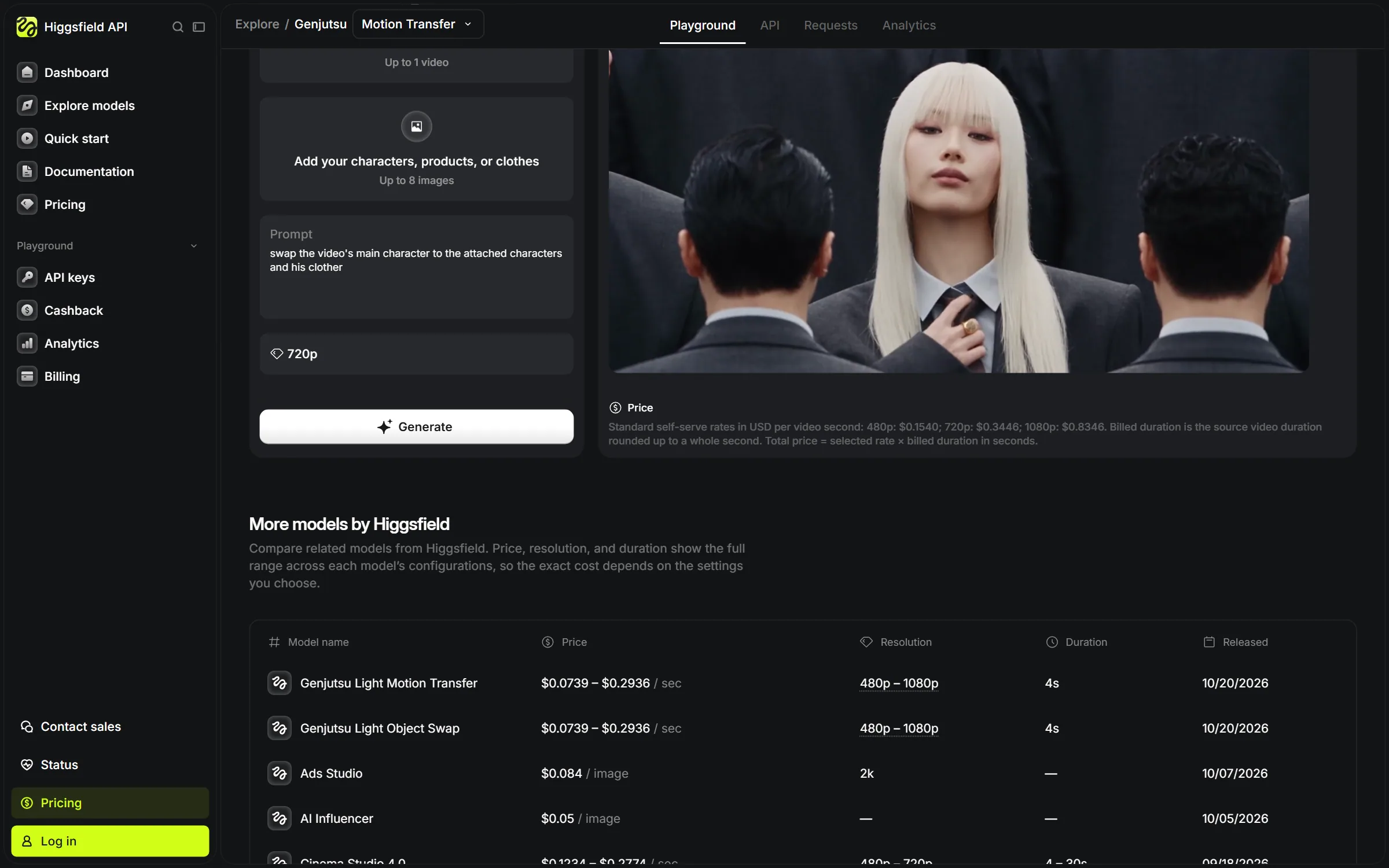
Higgsfield still wins on Wan 3.0 (~18% cheaper than Kinovi), Kling 4.0 Flash, its POST /estimate/{model} REST endpoint, official Python/TypeScript SDKs, and proprietary products (Genjutsu, Soul 2, Soul ID, Marketing Studio, Ads Studio). The honest answer for many teams is workload-based routing rather than an all-or-nothing switch.
Quick verdict (audited 2026-11-20): Keep Higgsfield for Wan 3.0 at scale, Kling 4.0 Flash, Genjutsu, and Soul. Move to Kinovi when Seedance 2.5 Edit/Extend, Kling 4.0 & Seedance 2.5 T2V parity without credit expiry, a unified Studio + API wallet, 30-day output retention, or one REST contract across models drives your engineering and budget decisions.
Higgsfield API vs Kinovi API at a Glance
| Dimension / Benchmark | Higgsfield API (open.higgsfield.ai) | Kinovi API (kinovi.ai/api/v1) | Winner / Difference |
|---|---|---|---|
| Seedance 2.5 Edit (1080p) | $0.7858/s | $0.3947/s | Kinovi (−49.8%) |
| Seedance 2.5 Edit (480p) | $0.1387/s | $0.0737/s | Kinovi (−46.9%) |
| Seedance 2.5 T2V (720p) | $0.2647/s | $0.2717/s | Parity (~2.6%) |
| Seedance 2.0 T2V (480p) | $0.0804/s | $0.0707/s | Kinovi (−12.1%) |
| Kling 4.0 T2V (720p / 1080p) | $0.1257/s / $0.1879/s | $0.1260/s / $0.1890/s | Parity (<0.6%) |
| Wan 3.0 T2V (720p / 1080p) | $0.0750/s / $0.1500/s | $0.0884/s / $0.1767/s | Higgsfield (~18% lower) |
| Balance expiry | 12 months after top-up | Never expires | Kinovi |
| Web UI + API wallet | Separate (site plan excluded from API) | One shared balance (Studio + API) | Kinovi |
| API contract | Per-model path & schema + Key id:secret | Unified POST /jobs/createTask + Bearer | Kinovi (single wrapper) |
| Output file retention | 7 days (expires_at) | 30 days (uploads 2 months) | Kinovi (4.3× longer) |
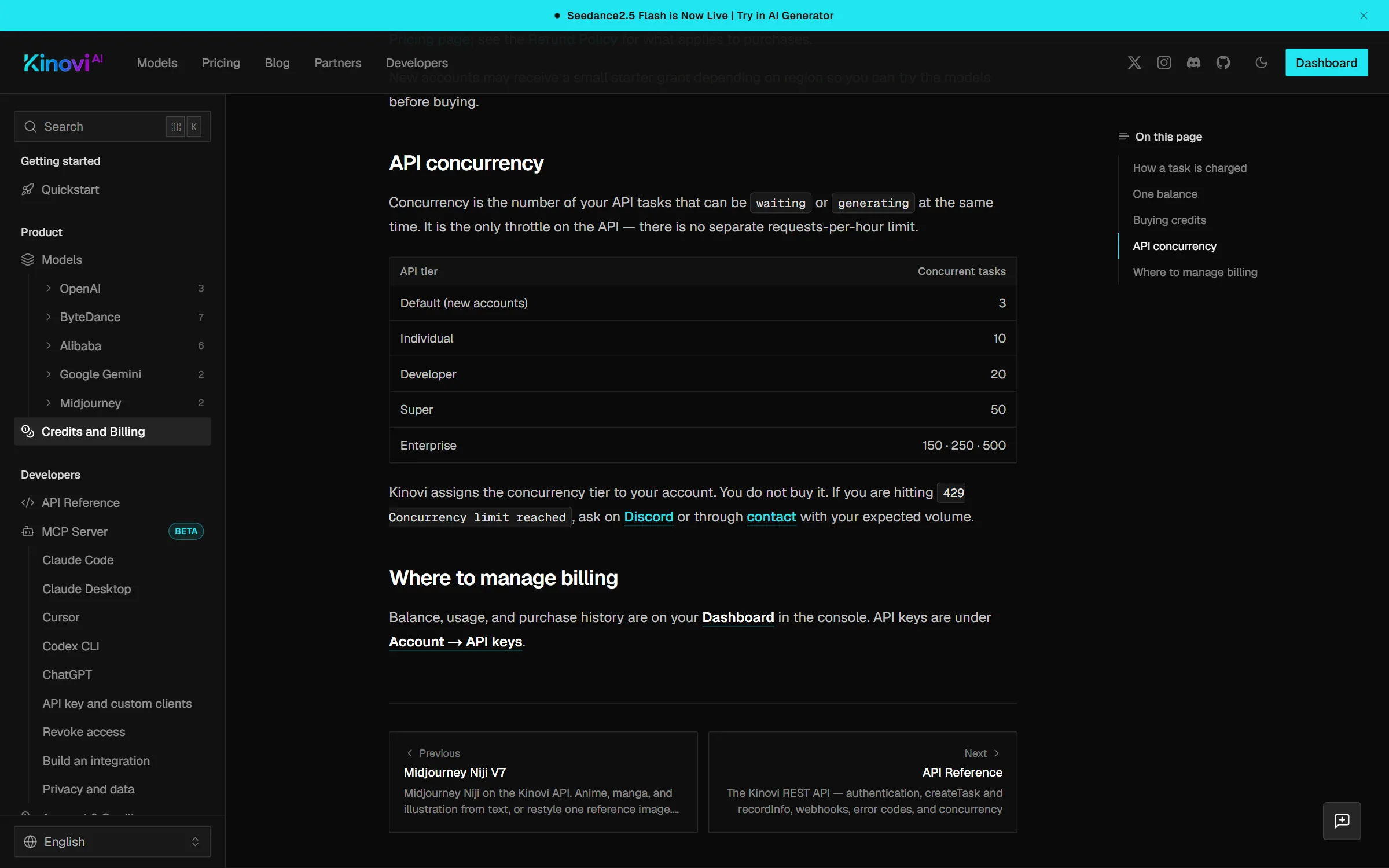
| New-account concurrency | 2 default (10 at $25 / 20 at $100 / 40 at $1k) | 3 default (10 / 20 / 50 / 150–500 by tier) | Self-serve top-up on Higgsfield; higher ceiling on Kinovi |
| Price estimate & SDKs | POST /estimate/{model}, Python & TS SDKs | Model pages + MCP estimate tool; OpenAPI REST | Higgsfield for REST estimate & SDKs |
What the Higgsfield API Actually Is
The Higgsfield AI API launched in September 2026 as a separate developer product from the consumer web app. You sign up at open.higgsfield.ai, add a payment method, fund a prepaid USD balance, and create a Higgsfield API key. Requests hit https://api.higgsfield.ai using a two-part header: Authorization: Key <key_id>:<key_secret>.
Higgsfield's documentation lists 84 entries: 17 image models and 67 video models. Most are third-party models (Seedance, Kling, Wan, MiniMax, LTX, PixVerse, Recraft, Ideogram, Grok), alongside Higgsfield's proprietary models and workflows (Soul, Soul ID, Marketing Studio, Ads Studio, and Genjutsu).
Every generation returns a request_id and a status_url, which you poll (or pair with a webhook) across states: queued, in_progress, completed, failed, nsfw, and canceled. Higgsfield also exposes a pre-flight estimate route (POST /estimate/{model}) and official Python and TypeScript SDKs.
Three operational rules define Higgsfield API pricing and usage:
- Split wallet: A
higgsfield.aiwebsite subscription does not cover API requests, and the two balances cannot be merged. - 12-month expiry & 7-day retention: API funds expire 12 months after top-up, and generated outputs are deleted 7 days after completion (surfaced in
expires_at). - Rolling concurrency tiers: New accounts start at 2 concurrent generations. Funding $25 in the past 28 days raises concurrency to 10; $100 raises it to 20; $1,000 raises it to 40. (Older posts still cite 20 at key creation, so treat the live pricing page as authoritative.)
Why Teams Look for a Higgsfield Alternative
Developers rarely switch video generation API providers over a single feature. Most teams start searching for a Higgsfield AI alternative when four billing and engineering constraints stack up:
- Unused balance expiry: If you top up $1,000, spend $600 over 12 months, and the remaining $400 expires, your effective cost rises to $1.67 per dollar of generation. That penalty never occurs with non-expiring credits.
- Split web-app vs API billing: Teams prototyping prompts in the consumer UI and shipping features via API have to fund, track, and reconcile two separate wallets on Higgsfield.
- High Seedance 2.5 edit/reference pricing: Ad and post-production teams iterating on existing footage pay nearly 2× more per second on Higgsfield for Seedance 2.5 Edit/Extend than on Kinovi.
- Per-model schema maintenance & 7-day file expiry: Supporting five models on Higgsfield requires five model-specific request adapters, and outputs vanish in 7 days unless copied immediately.
Takeaway: Both Higgsfield and Kinovi resell upstream models (ByteDance, Kuaishou, Alibaba), so list prices on either platform can move when upstream providers reprice—for instance, Seedance 2.5 480p dropped from ~$0.20/s earlier in 2026 to $0.1177/s. The durable differences are wallet rules, edit-mode billing, API uniformity, and retention.
Six Criteria for Comparing Video Generation APIs
Before committing engineering time to any Higgsfield alternative, benchmark these six dimensions side by side:
- Exact per-second rate at your shipping resolution and mode—a 480p "from" price says nothing about a 1080p video edit.
- Model coverage at the current version (e.g., Seedance 2.5 vs 2.0, Kling 4.0 vs 4.0 Flash, Wan 3.0 vs Prime).
- Wallet and refund mechanics—reservation at submit, failure refunds, and whether unused funds expire.
- API contract ergonomics—unified envelope vs per-model schemas, webhooks, and pre-flight cost estimates.
- Day-one concurrency, tier upgrades, and output retention windows.
- Commercial output rights and training-data policies.
Higgsfield API Pricing vs Kinovi: Model-by-Model Comparison
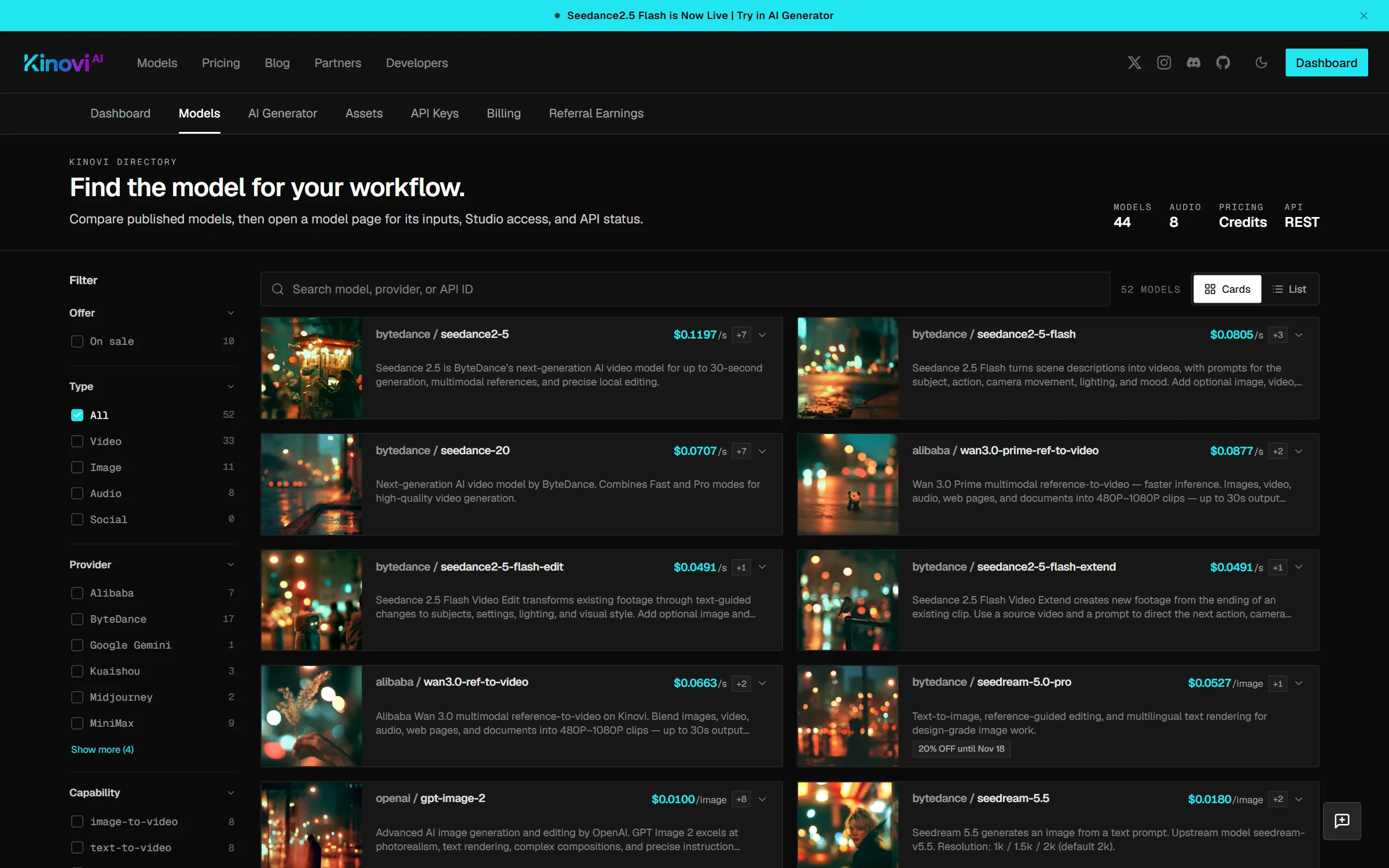
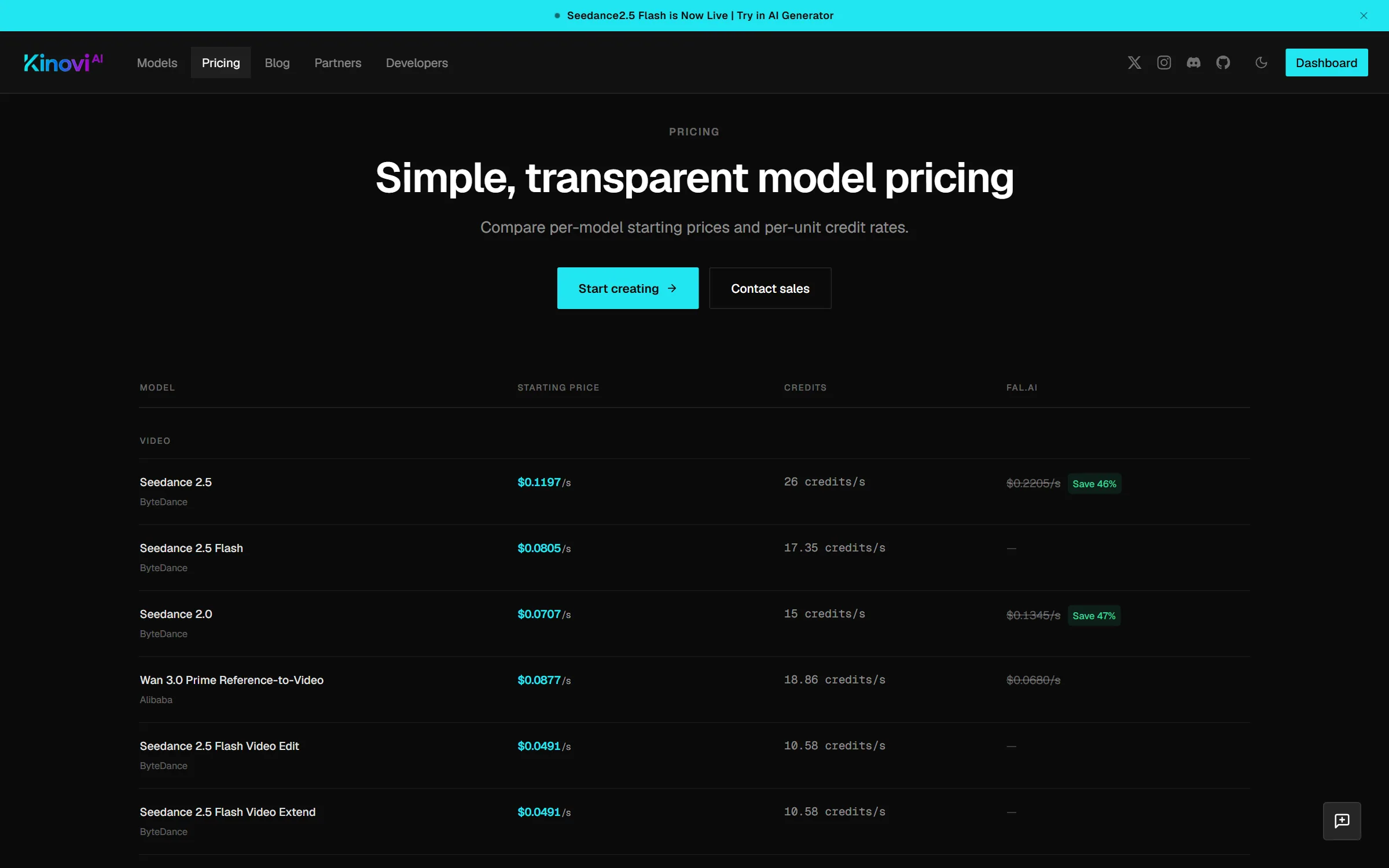
All figures below are standard self-serve rates in USD per second of output checked on 20 November 2026 (no enterprise discounts). Kinovi credit rates are converted at the standard $9.99 per 2,150 credits package (~$0.00465/credit).
| Model | Resolution | Higgsfield | Kinovi | Cheaper Platform |
|---|---|---|---|---|
| Kling 4.0 | 720p | $0.1257 | $0.1260 | Parity (+0.2%) |
| Kling 4.0 | 1080p | $0.1879 | $0.1890 | Parity (+0.6%) |
| Kling 4.0 Flash | 720p | $0.0940 | Not offered | Higgsfield only |
| Seedance 2.5 | 480p | $0.1177 | $0.1197 | Parity |
| Seedance 2.5 | 720p | $0.2647 | $0.2717 | Parity |
| Seedance 2.5 | 1080p | $0.6518 | $0.6604 | Parity |
| Seedance 2.5 Edit | 480p | $0.1387 | $0.0737 | Kinovi (−46.9%) |
| Seedance 2.5 Edit | 1080p | $0.7858 | $0.3947 | Kinovi (−49.8%) |
| Seedance 2.0 | 480p | $0.0804 | $0.0707 | Kinovi (−12.1%) |
| Seedance 2.0 | 720p | $0.1735 | $0.1884 | Higgsfield (+8.6% on Kinovi) |
| Seedance 2.0 | 1080p | $0.4293 | $0.4239 | Kinovi (−1.3%) |
| Seedance 2.0 | 4K | $0.8907 | $0.9420 | Higgsfield (+5.8% on Kinovi) |
| Wan 3.0 | 480p | $0.0375 | $0.0442 | Higgsfield (+17.9% on Kinovi) |
| Wan 3.0 | 720p | $0.0750 | $0.0884 | Higgsfield (+17.9% on Kinovi) |
| Wan 3.0 | 1080p | $0.1500 | $0.1767 | Higgsfield (+17.8% on Kinovi) |
Sources: Higgsfield API Pricing and individual Kinovi model pricing tabs.
Kling 4.0 API Pricing
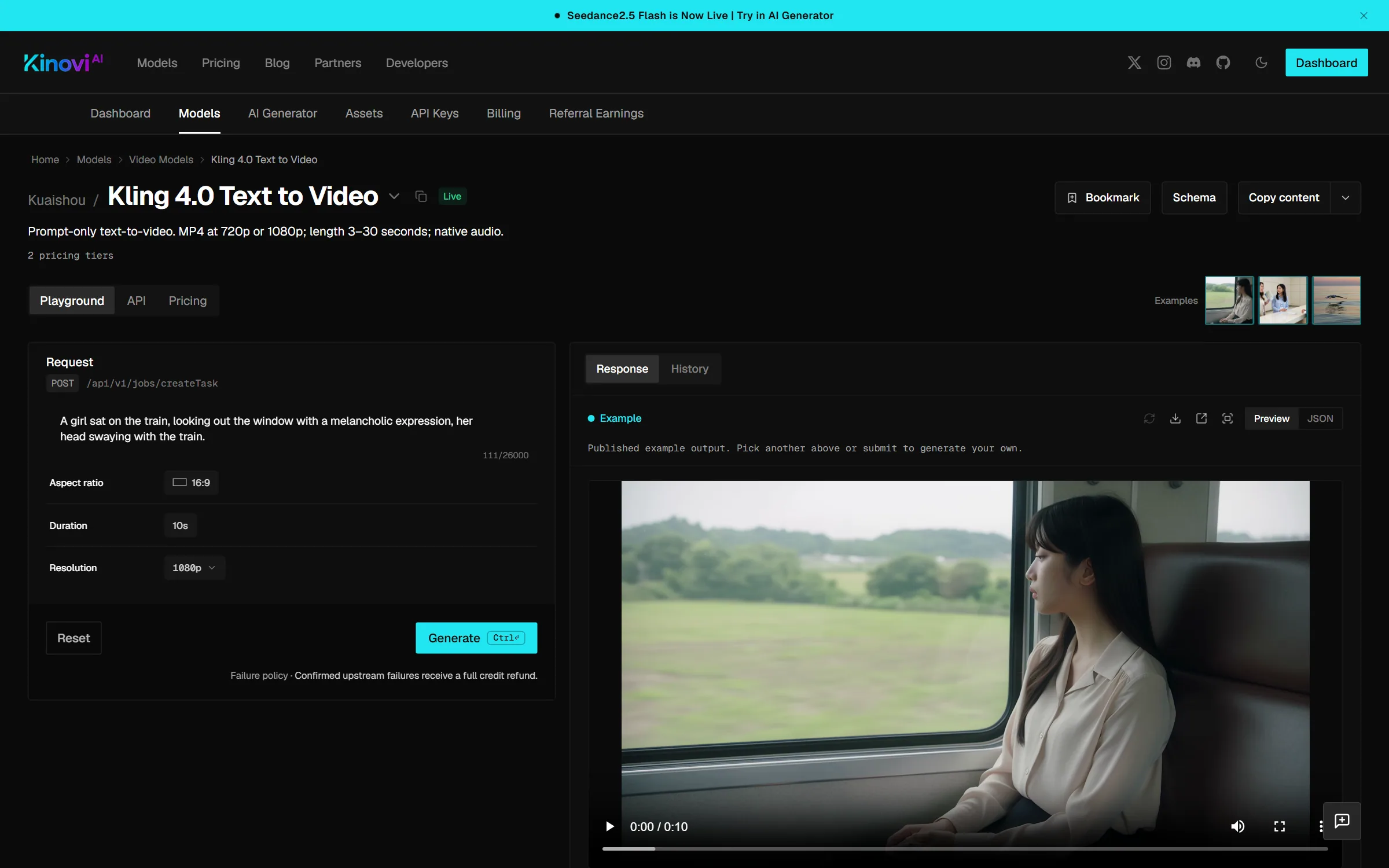
Kinovi splits Kling 4.0 into three dedicated routes—text-to-video, image-to-video, and reference-to-video—supporting 3–30 second clips at 720p or 1080p (default 10s, 1080p; text prompts up to 26,000 characters). See live per-second credit and USD rates on the Kinovi Kling 4.0 pricing tab.
| Kinovi Kling 4.0 Model | Inputs | Duration | 720p | 1080p |
|---|---|---|---|---|
| Text-to-Video | Text prompt | 3–30s | $0.1260/s | $0.1890/s |
| Image-to-Video | Text + 1–10 keyframes | 3–30s | $0.1260/s | $0.1890/s |
| Reference-to-Video (no ref video) | Text + up to 10 images or 5 clips | 3–30s | $0.1260/s | $0.1890/s |
| Reference-to-Video (with ref video) | Billed per reference + output second | 3–30s | $0.0756/s | $0.1134/s |
On Higgsfield, Kling 4.0 combines text, image, reference, and video-edit modes under one page at $0.1257/s (720p) and $0.1879/s (1080p)—essentially at parity with Kinovi ($0.1260/s and $0.1890/s). Higgsfield also offers Kling 4.0 Flash at $0.0940/s (720p), which Kinovi does not carry.
Seedance 2.5 and Seedance 2.0 API Pricing
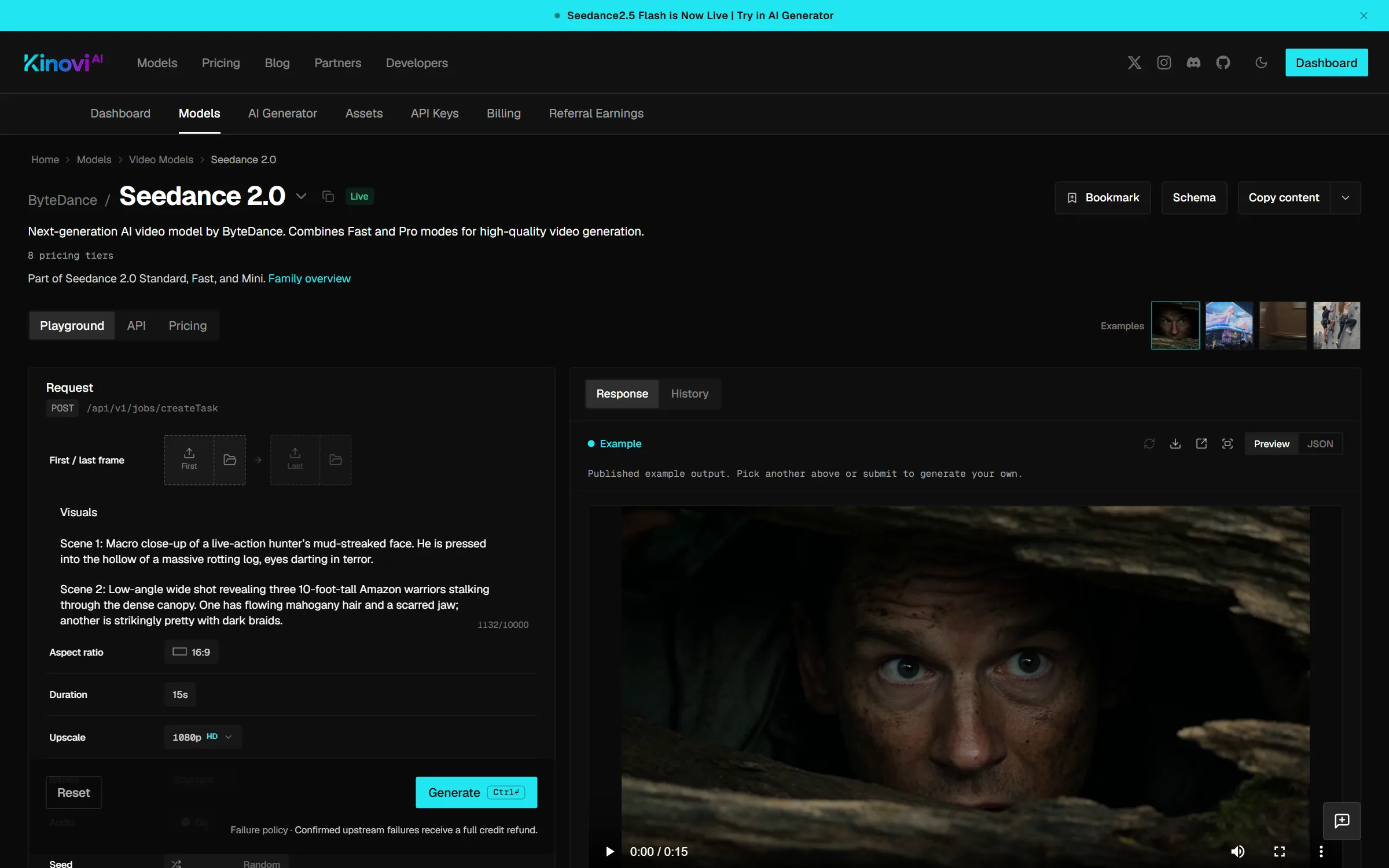
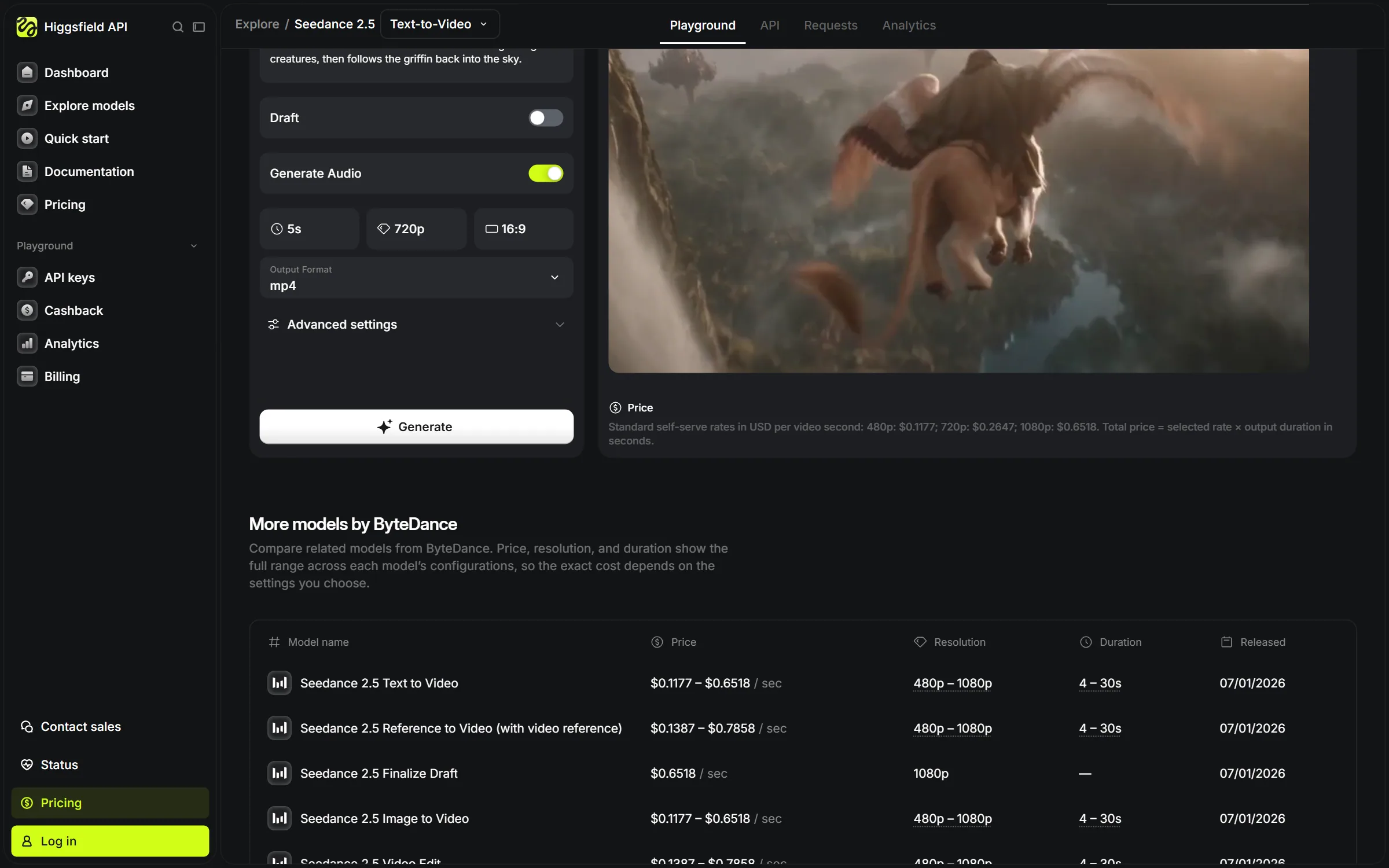
Seedance 2.5 on Kinovi runs 4–30 second clips at 480p, 720p, 1080p, and 4K (note: confirm live 1080p/4K generation availability on the model page before depending on them, as availability can be gated to 480p/720p even when listed in the schema). It accepts up to 30 images, 10 reference videos, and 10 audio files, referencing assets inline as @Image1, @Video1, or using first/last keyframes. See also How to Choose a Seedance 2.5 API.
Here is where Kinovi creates a ~50% pricing gap: Seedance 2.5 Edit and Seedance 2.5 Extend bill on Kinovi's reference-video rate—$0.0737/s at 480p, $0.1612/s at 720p, $0.3947/s at 1080p, and $0.6720/s at 4K—compared to Higgsfield's $0.1387/s (480p) and $0.7858/s (1080p).
| Kinovi Seedance 2.5 Model | Inputs | Duration | 480p | 720p | 1080p |
|---|---|---|---|---|---|
| Seedance 2.5 | Text or 1–2 keyframes | 4–30s | $0.1197/s | $0.2717/s | $0.6604/s |
| Seedance 2.5 (reference video) | Text + up to 10 reference videos | 4–30s | $0.0737/s | $0.1612/s | $0.3947/s |
| Seedance 2.5 Edit | Existing footage + prompt + refs | 4–30s | $0.0737/s | $0.1612/s | $0.3947/s |
| Seedance 2.5 Extend | Clip to continue | 4–30s | $0.0737/s | $0.1612/s | $0.3947/s |
Seedance 2.0 on Kinovi runs 4–15 second clips at 480p–4K (up to 9 images, 3 videos, 3 audio files). At 480p, Kinovi undercuts Higgsfield ($0.0707/s vs $0.0804/s); at 1080p they are within 1.3% ($0.4239/s vs $0.4293/s); at 720p and 4K, Higgsfield is slightly lower.
| Kinovi Seedance 2.0 Model | Inputs | Duration | 480p | 720p | 1080p | 4K |
|---|---|---|---|---|---|---|
| Seedance 2.0 | Text + up to 9 images, 3 videos, 3 audio | 4–15s | $0.0707/s | $0.1884/s | $0.4239/s | $0.9420/s |
| Seedance 2.0 (reference video) | Same inputs, reference pricing | 4–15s | $0.0895/s | $0.2261/s | $0.5087/s | $1.1305/s |
Wan 3.0 API Pricing
Higgsfield prices Wan 3.0 at $0.0375/s (480p), $0.0750/s (720p), and $0.1500/s (1080p) for 2–30s clips, plus a Prime tier at $0.051–$0.21/s. Kinovi's Wan 3.0 rates are roughly 18% higher across standard tiers:
| Kinovi Wan 3.0 Model | Inputs | Duration | 480p | 720p | 1080p |
|---|---|---|---|---|---|
| Text-to-Video | Text prompt | 2–30s | $0.0442/s | $0.0884/s | $0.1767/s |
| Image-to-Video | 1–2 keyframes | 2–30s | $0.0442/s | $0.0884/s | $0.1767/s |
| Reference-to-Video | Images, video, audio, web pages, docs | 2–30s (ref + out ≤ 30s) | $0.0442/s | $0.0884/s | $0.1767/s |
| Prime Text-to-Video | Text prompt, faster inference | 2–30s | $0.0658/s | $0.1354/s | $0.2709/s |
| Prime Image-to-Video | 1–2 keyframes, faster inference | 2–30s | $0.0658/s | $0.1354/s | $0.2709/s |
Takeaway: If Wan 3.0 is your primary volume model, stay on Higgsfield. Use Kinovi's Wan 3.0 routes only when you already consolidate other models on Kinovi and want a single wallet.
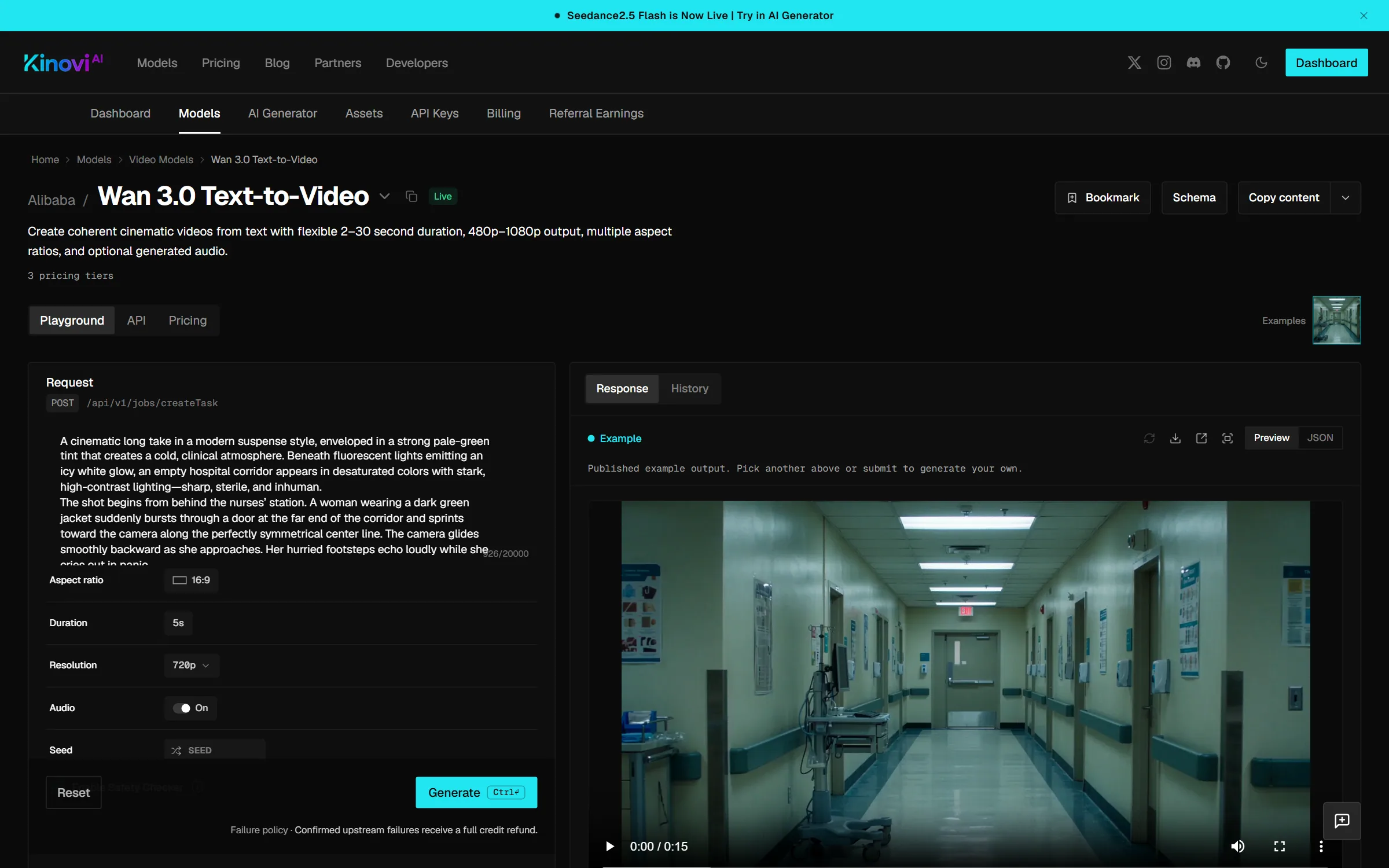
Image Models: Catalog Differences
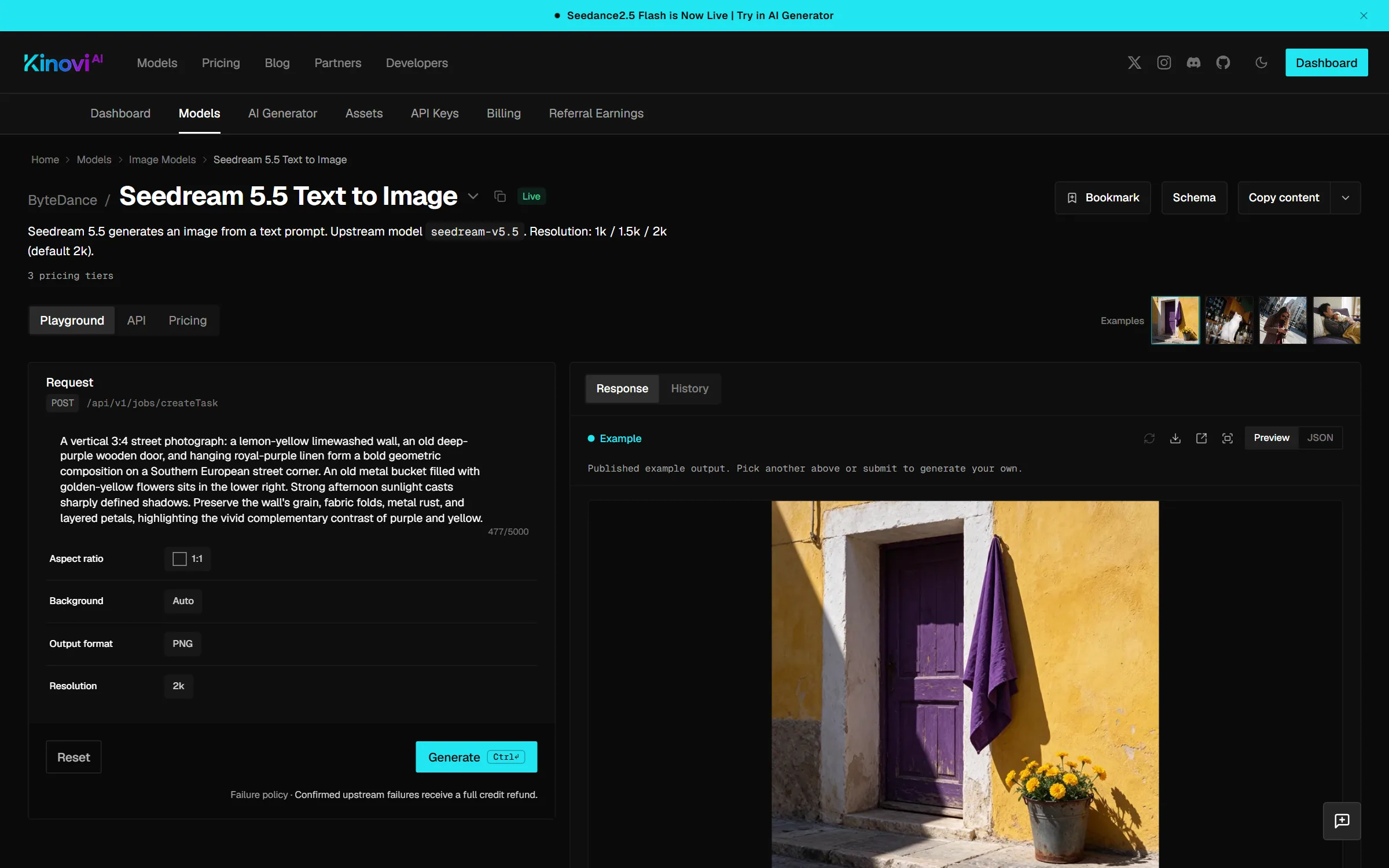
Image catalogs overlap in only one place (Seedream 5.0 Pro). Every other model is unique to one platform (prices per image unless noted):
| Image Model | Kinovi | Higgsfield |
|---|---|---|
| Seedream 5.0 Pro | $0.0527 (1K) / $0.0904 (2K) | $0.054–$0.108 (1K–2K) |
| Qwen Image 2.1 | $0.0928 (1K) / $0.3016 (2K) | Not offered |
| Qwen Image 3 | Not offered | From $0.040 |
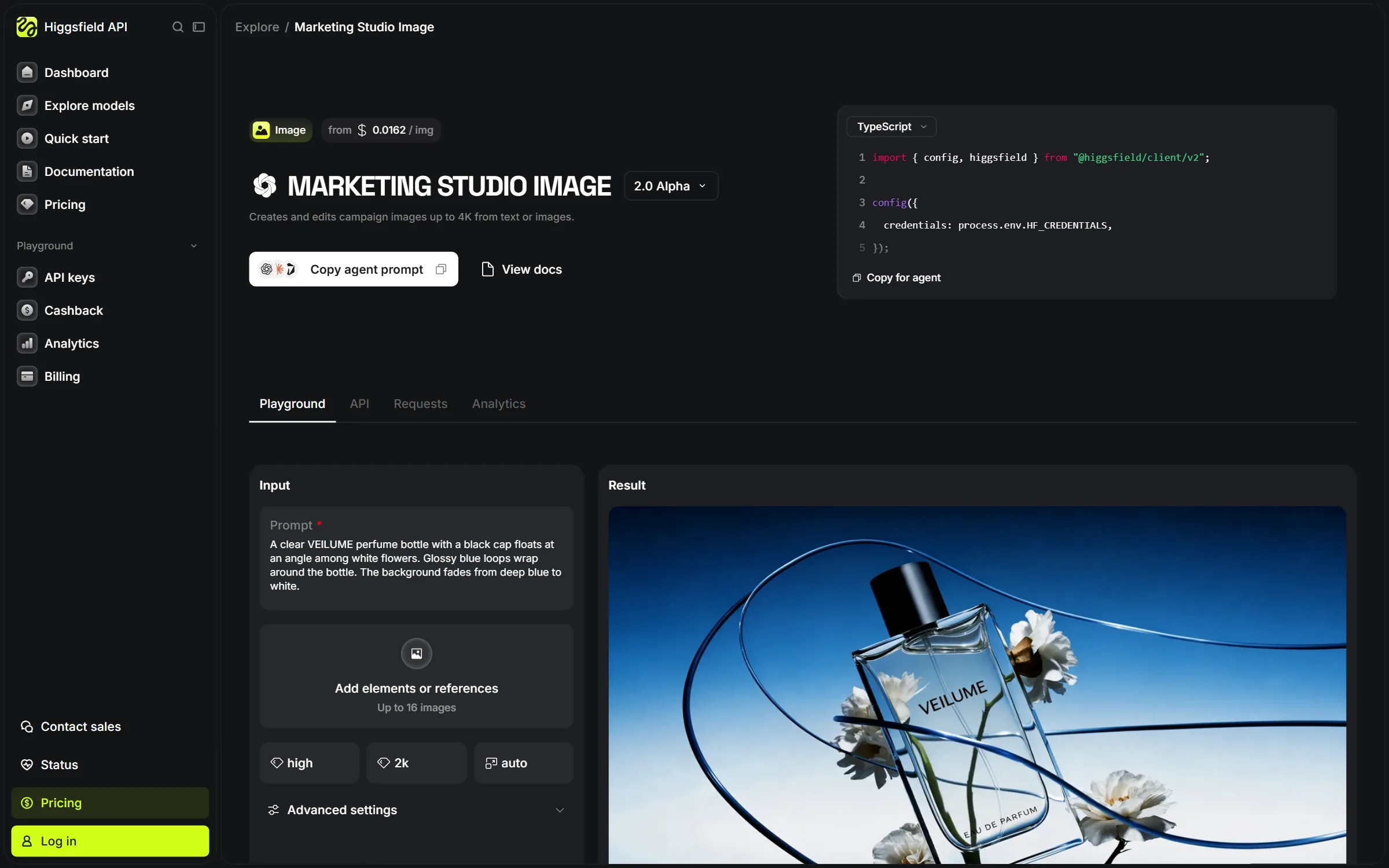
| GPT Image 2 | $0.01 (low 1K) – $0.72 (high 4K) | Not offered |
| GPT Image 2.5 Flare / Sunburst | Token-billed | Not offered |
| Midjourney V7 / V8 / Niji V7 | $0.0565 per 4-image grid | Not offered |
| Nano Banana Pro | $0.067 (1K/2K) / $0.12 (4K) | Not offered |
| Nano Banana 2 | $0.0707 (2K) / $0.1178 (4K) | Not offered |
| Seedream 5.5 / 5.5 Edit | $0.018 (1K) / $0.0315 (2K) | Not offered |
| Soul 2 / Soul Standard | Not offered | From $0.003 / from $0.094 |
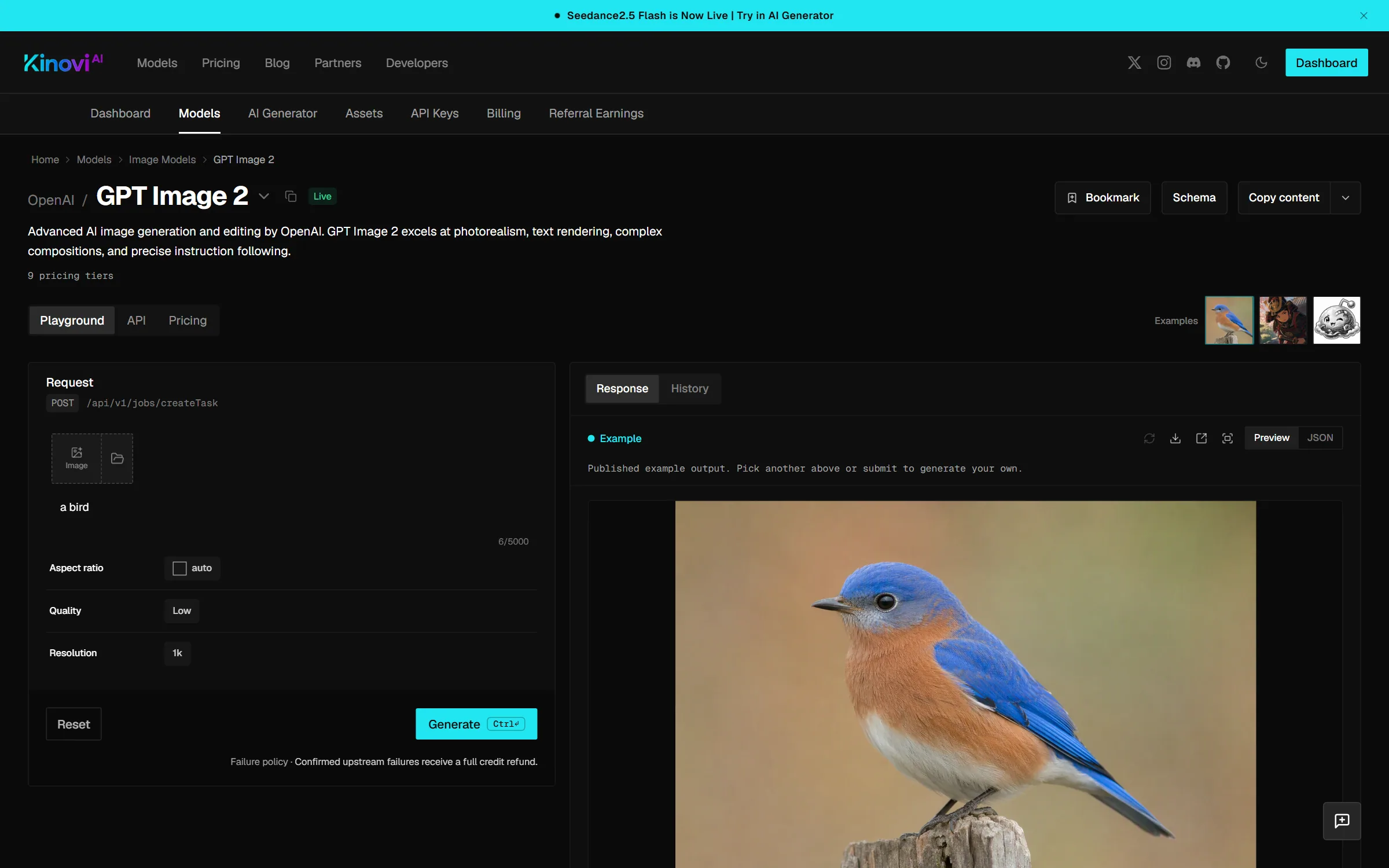
| Marketing Studio Image / AI Influencer | Not offered | From $0.013 / $0.050 |
| Grok Imagine 2.0 / Recraft 4.1 / Ideogram 4.0 | Not offered | From $0.040 / $0.035 / $0.030 |
| Z-Image Turbo / Kling Image 4.0 (up to 8K) | Not offered | $0.015 / from $0.063 |
On Kinovi, GPT Image 2 separates quality and resolution across nine tiers ($0.01 low 1K to $0.72 high 4K), Midjourney V8 bills $0.0565 per four-image grid, Nano Banana Pro supports multi-reference character consistency, and Seedream 5.5 is $0.018 at 1K (+$0.0072 per edit input image). On Higgsfield, Kling Image 4.0 reaches 8K for print deliverables, and Marketing Studio Image / AI Influencer bundle preset workflows.
What Only Higgsfield Has
Higgsfield's proprietary lineup has no Kinovi equivalent: Genjutsu (motion transfer, object swap, Restyle at $0.1540/s, $0.3446/s, and $0.8346/s for 480p/720p/1080p; Genjutsu Light from $0.0739/s), Soul 2, Soul Standard, Soul ID training, Marketing Studio, and Ads Studio—plus Kling Image 4.0 (8K) and Kling 4.0 Flash (720p).
Real Monthly Cost Scenarios: Higgsfield API vs Kinovi
Scenario A: Solo Developer (50 × 5s 720p Clips / Month)
Split evenly between Kling 4.0 and Seedance 2.5:
| Workload | Higgsfield | Kinovi |
|---|---|---|
| 25 × 5s Kling 4.0 (720p) | $15.71 | $15.75 |
| 25 × 5s Seedance 2.5 (720p) | $33.09 | $33.96 |
| Monthly Total | $48.80 | $49.71 |
Kinovi is ~$0.91/month (+1.9%) higher on pure generation spend—effectively parity, and far smaller than the risk of letting unused Higgsfield balance expire after 12 months.
Scenario B: SaaS Product at Volume (2,000 × 10s 1080p Clips / Month)
| Model (2,000 × 10s, 1080p) | Higgsfield | Kinovi | Delta |
|---|---|---|---|
| Seedance 2.5 T2V | $13,036 | $13,208 | +1.3% (near parity) |
| Kling 4.0 T2V | $3,758 | $3,780 | +0.6% (near parity) |
| Wan 3.0 T2V | $3,000 | $3,535 | +17.8% on Kinovi |
At volume, Wan 3.0 still favors Higgsfield on unit cost (~18% lower), while both Kling 4.0 T2V and Seedance 2.5 T2V sit at virtual parity—making wallet expiry, Studio sharing, 30-day retention, and API simplicity the real tiebreakers.
Scenario C: Ad Team Iterating on Existing Footage (300 × 8s 1080p Edits + 1,000 Stills / Month)
| Workload | Higgsfield | Kinovi |
|---|---|---|
| 300 × 8s Seedance 2.5 Video Edit (1080p) | $1,885.92 | $947.28 |
| 1,000 product images (1K) | $16.20 (Marketing Studio, 1K low) | $18.00 (Seedream 5.5, 1K) |
| Monthly Total | $1,902.12 | $965.28 (−49.3%) |
An ad or creative-ops team iterating on client-approved footage saves $936.84/month (~49%) on Kinovi because of the Seedance 2.5 Edit reference rate.
Developer Migration Guide: Moving from Higgsfield API to Kinovi
Kinovi's REST API exposes five core routes: createTask, recordInfo, uploads, account, and upgradeDraft. Unlike Higgsfield's per-model endpoint paths and schemas, every Kinovi model uses the exact same request envelope.
Endpoint and Field Mapping (Higgsfield → Kinovi)
| Concept | Higgsfield API | Kinovi API |
|---|---|---|
| Base URL | https://api.higgsfield.ai | https://kinovi.ai/api/v1 |
| Authentication | Authorization: Key <key_id>:<key_secret> | Authorization: Bearer <KINOVI_API_KEY> |
| Submit endpoint | Model-specific generation path | POST /jobs/createTask |
| Job ID | request_id | taskId |
| Status polling | status_url from submit response | GET /jobs/recordInfo?taskId=... |
| Status states | queued, in_progress, completed, failed, nsfw, canceled | waiting, generating, success, fail |
| Output URLs | images[], video.url, audio.url | output[0].url |
| Price estimate | POST /estimate/{model} | Model page rates (or Kinovi MCP estimate_cost) |
| Webhooks | Webhook deduplicated by request_id | callBackUrl in request body |
| File uploads | Documented file-upload flow | POST /uploads |
| Account balance | Console analytics | GET /account |
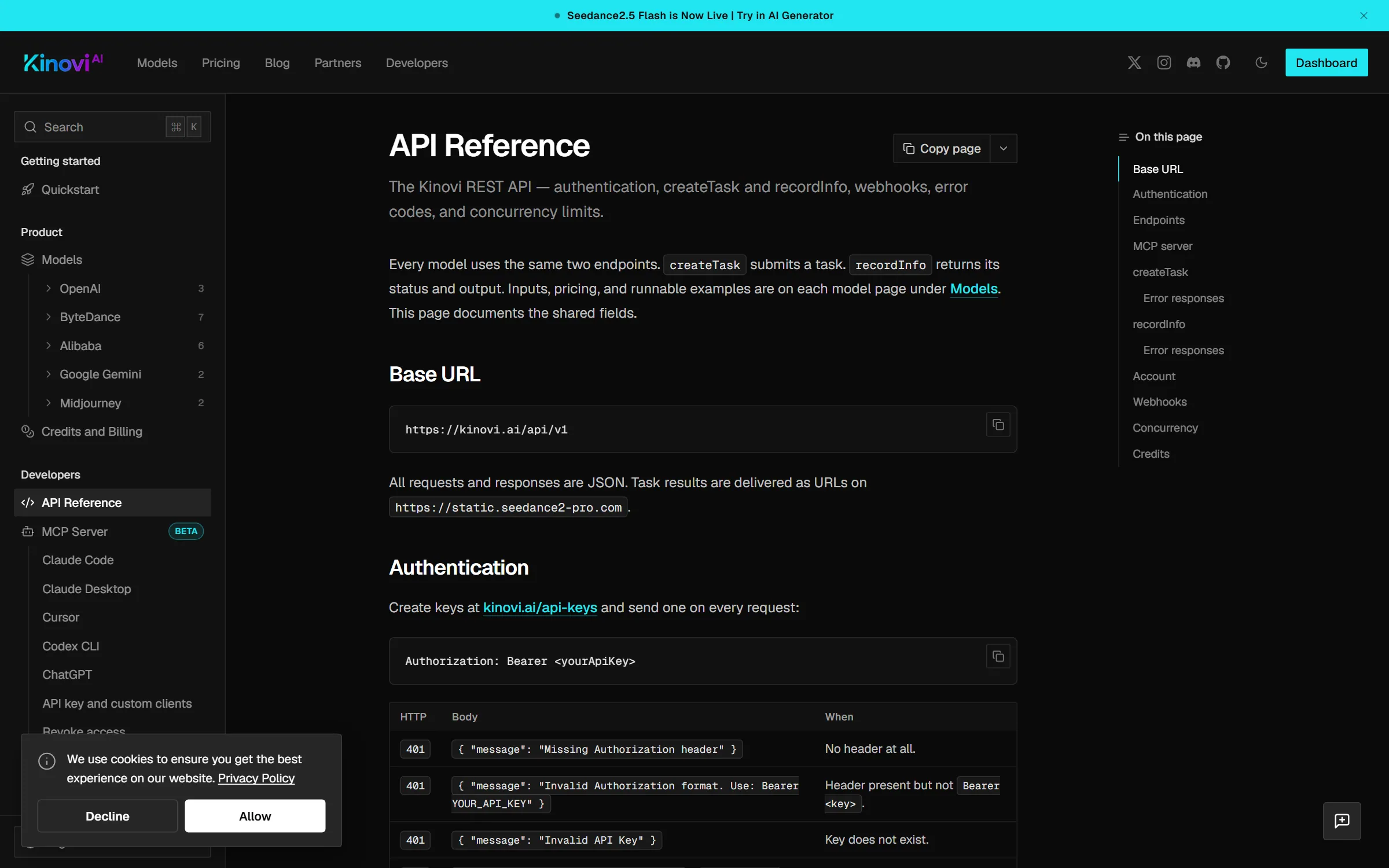
POST /api/v1/jobs/createTask, and GET /api/v1/jobs/recordInfo. Source: Kinovi API Reference.Before: Higgsfield TypeScript Client
// Higgsfield: the generation path and body are model-specific.
// Read them from the model's API page; only the envelope is shared.
const created = await fetch(`${HF_BASE}${generationPath}`, {
  method: "POST",
  headers: {
    Authorization: `Key ${process.env.HF_API_KEY_ID}:${process.env.HF_API_KEY_SECRET}`,
    "Content-Type": "application/json",
    "Idempotency-Key": crypto.randomUUID(),
  },
  body: JSON.stringify(modelSpecificBody),
});

const { request_id, status_url } = await created.json();

// Poll the URL the API returned; do not construct it yourself.
while (true) {
  const status = await fetch(status_url, { headers: { Authorization: hfAuth } }).then((r) => r.json());
  if (["completed", "failed", "nsfw", "canceled"].includes(status.status)) break;
  await new Promise((r) => setTimeout(r, 3000));
}
After: Same Job on Kinovi (TypeScript, Python & cURL)
TypeScript client:
const KINOVI = "https://kinovi.ai/api/v1";
const auth = { Authorization: `Bearer ${process.env.KINOVI_API_KEY}` };

// Submit a task; every model uses the same createTask envelope.
const created = await fetch(`${KINOVI}/jobs/createTask`, {
  method: "POST",
  headers: { ...auth, "Content-Type": "application/json" },
  body: JSON.stringify({
    model: "seedance2-5",
    inputs: {
      prompt,
      imageUrls: [firstFrame],      // First-frame reference.
      videoUrls: [motionReference], // A video shifts the job to reference pricing.
      duration: 5,
      outputResolution: "720p",
      aspectRatio: "16:9",
      generate_audio: false,
    },
    callBackUrl: "https://your.app/hooks/kinovi",
  }),
});

const { taskId } = await created.json();

// Poll until the task reaches a terminal state.
let info;
for (let i = 0; i < 120; i += 1) {
  const res = await fetch(`${KINOVI}/jobs/recordInfo?taskId=${taskId}`, { headers: auth });
  if (res.status === 429) throw new Error("Concurrency limit reached");
  info = await res.json();
  if (info.status === "success" || info.status === "fail") break;
  await new Promise((r) => setTimeout(r, 2000));
}

if (info.status === "fail") throw new Error(`${info.error.code}: ${info.error.message}`);
console.log(info.output[0].url, info.creditsUsed);
Python client (for teams migrating off higgsfield-client):
import os
import time
import requests

KINOVI = "https://kinovi.ai/api/v1"
AUTH = {"Authorization": f"Bearer {os.environ['KINOVI_API_KEY']}"}

created = requests.post(
    f"{KINOVI}/jobs/createTask",
    headers={**AUTH, "Content-Type": "application/json"},
    json={
        "model": "seedance2-5",
        "inputs": {
            "prompt": "Product turntable on white",
            "duration": 5,
            "outputResolution": "720p",
            "aspectRatio": "16:9",
        },
    },
    timeout=60,
)
created.raise_for_status()
task_id = created.json()["taskId"]

while True:
    res = requests.get(f"{KINOVI}/jobs/recordInfo", params={"taskId": task_id}, headers=AUTH, timeout=30)
    if res.status_code == 429:
        raise RuntimeError("Concurrency limit reached")
    res.raise_for_status()
    info = res.json()
    if info["status"] in ("success", "fail"):
        break
    time.sleep(2)

if info["status"] == "fail":
    raise RuntimeError(info.get("error"))
print(info["output"][0]["url"], info.get("creditsUsed"))
Single-call cURL quick test:
curl -X POST https://kinovi.ai/api/v1/jobs/createTask \
  -H "Authorization: Bearer $KINOVI_API_KEY" \
  -H "Content-Type: application/json" \
  -d '{"model":"seedance2-5","inputs":{"prompt":"Product turntable on white","duration":5,"outputResolution":"720p"}}'
Local reference images and videos go through POST /api/v1/uploads first, returning a public URL for imageUrls or videoUrls. If you build AI agents, Kinovi's hosted MCP server exposes all models, your shared balance, and an estimate_cost tool directly to Claude Code, Cursor, Codex CLI, and ChatGPT. For queue and webhook handling patterns, see the Kinovi API Reference.
5-Step Zero-Downtime Migration Checklist
- Keep the Higgsfield client behind an interface and move
HF_API_KEY_ID/KINOVI_API_KEYinto environment variables. - Map one model first—
seedance2-5orseedance2-5-editis the cleanest benchmark against the pricing table above. - Shadow-test in parallel with identical prompts and references; compare output quality, latency, and
creditsUsed. - Shift Seedance 2.5 Edit and Extend traffic first, where Kinovi's ~50% per-second savings take effect immediately.
- Keep Higgsfield active as a fallback (or permanent route for Wan 3.0, Kling 4.0 Flash, Genjutsu, and Soul) until production telemetry is verified.
Billing, Refunds, Retention, and Concurrency
| Operational Rule | Higgsfield API | Kinovi API |
|---|---|---|
| Billing unit | USD prepaid balance | Credits (2,150 for $9.99) |
| Balance expiry | 12 months after top-up | Never expires |
| Shared with web UI | No (separate from site subscription) | Yes, one shared balance (Studio + API) |
| Reserved at submit | Yes | Yes |
| Failed job refund | Refunded on failed or nsfw | Refunded on provider failure, timeout, or cancellation |
| Off-brief success | Charged | Charged |
| Output retention | 7 days | 30 days (uploads retained 2 months) |
| Concurrency | 2 default; 10 ($25), 20 ($100), 40 ($1k in 28 days) | 3 default; 10, 20, 50, and 150–500 by assigned tier |
| Rate-limit error | Model-dependent | 429 Concurrency limit reached |
Takeaway: A new Kinovi account starts at 3 concurrent jobs (only 1 above Higgsfield's default of 2). Higher Kinovi tiers—Developer (20), Super (50), Enterprise (150–500)—are assigned rather than self-serve purchased. Confirm your tier before migrating bursty pipelines, and always copy finished assets to your own object storage before the 7-day or 30-day retention window closes.
When You Should Stay on Higgsfield
Stay on Higgsfield—or keep it in a multi-provider router—when:
- Proprietary models drive your product: Genjutsu, Soul 2, Soul ID, Marketing Studio, Ads Studio, Kling Image 4.0 (8K), and Kling 4.0 Flash have no Kinovi equivalent.
- Wan 3.0 or Kling 4.0 Flash dominates your invoice: Wan 3.0 is ~18% cheaper on Higgsfield, and Kling 4.0 Flash ($0.0940/s) is not offered on Kinovi (standard Kling 4.0 is at parity).
- Finance requires USD-per-request accounting rather than credit conversion, and your spend easily clears the 12-month top-up expiry window.
Other Higgsfield API Alternatives Worth Comparing
If you are benchmarking the wider video generation API market beyond Higgsfield and Kinovi:
| Platform | Best Fit | Key Tradeoff |
|---|---|---|
| Kinovi | Unified createTask envelope, ~50% lower Seedance 2.5 Edit/Extend, Kling 4.0 & Seedance 2.5 parity, non-expiring shared Studio + API credits | Higher Wan 3.0 rates (~18%); no Genjutsu/Soul or Kling 4.0 Flash |
| fal.ai | Broadest third-party serverless catalog and mature JS/Python SDKs (Higgsfield vs fal.ai) | Per-endpoint schemas; see fal.ai alternatives |
| WaveSpeedAI | Broad multi-modal aggregator with instant Silver concurrency after top-up | 7-day retention; compare in our WaveSpeed API alternative guide |
| Runway API | First-party Gen-series cinematic video models (Higgsfield vs Runway) | Single-vendor catalog; see Runway API alternatives |
| kie.ai | Low-cost aggregator with prepaid credit packs | Check model-specific pricing; see kie.ai alternatives |
| Kling official API | First-party Kling access when Kling is 90%+ of volume | Separate auth, quota, and billing per vendor |
Who Kinovi Fits Best
Kinovi is built for teams generating across multiple model families that want one REST contract, one shared wallet, and credits that never expire:
- Independent developers shipping a video feature without writing a separate adapter per vendor.
- SaaS teams prototyping in Studio and running production jobs from the exact same balance.
- Ad and creative-ops teams iterating on client footage with Seedance 2.5 Edit/Extend at nearly half Higgsfield's rate.
- AI agent builders calling image and video models via Kinovi's hosted MCP server.
Frequently Asked Questions
What is the best Higgsfield API alternative for developers?
For multi-model teams running Seedance 2.5 Edit/Extend (46.9%–49.8% lower per second), Seedance 2.0 480p, GPT Image 2, Midjourney V8, or Nano Banana 2, Kinovi offers one unified createTask / recordInfo envelope, non-expiring shared Studio + API credits, and 30-day output retention. For Wan 3.0 at scale, Kling 4.0 Flash, Genjutsu, or Soul 2, stay on Higgsfield or compare fal.ai, WaveSpeedAI, and Runway.
How does Higgsfield API pricing differ from a Higgsfield website subscription?
The Higgsfield API (open.higgsfield.ai) is billed separately from higgsfield.ai website plans. Subscription credits cannot be used for API calls, balances cannot be merged, and unused Higgsfield API top-ups expire after 12 months. Kinovi uses one non-expiring balance across Studio and the API.
Is there a Higgsfield API free tier or free trial?
Neither platform offers a standing free API tier for production workloads—paid work requires a funded balance. Kinovi may provide a small regional starter grant of free credits for new accounts (credits & billing), and purchased Kinovi credits never expire, so evaluation spend is never lost.
Can I migrate existing Higgsfield API code directly to Kinovi?
request_id maps to taskId, status polling moves to GET /api/v1/jobs/recordInfo, auth becomes Authorization: Bearer, and webhooks move to callBackUrl. Because Higgsfield uses per-model schemas and Kinovi uses one shared envelope, remap the path, inputs, status values, and billing unit per model, then verify one live job before shifting traffic.
How do Higgsfield, Kinovi, fal.ai, and Runway compare as video generation APIs?
Higgsfield leads on Wan 3.0, Kling 4.0 Flash, and proprietary Genjutsu/Soul workflows, while standard Kling 4.0 and Seedance 2.5 T2V are at parity. Kinovi leads on Seedance 2.5 Edit/Extend pricing, unified REST ergonomics, 30-day retention, and non-expiring credits. fal.ai offers the broadest serverless third-party catalog, while Runway focuses on first-party Gen-series models.
Which SDKs and MCP integrations are supported?
Higgsfield ships official Python and TypeScript SDKs alongside REST. Kinovi is REST-first with an OpenAPI spec at /openapi.json, cURL/Python/TypeScript examples on every model page, and a hosted MCP server with a built-in cost-estimate tool.
What happens if a generation fails?
Both platforms refund technical failures. Higgsfield refunds failed and nsfw jobs; Kinovi refunds provider failures, timeouts, and cancellations from the reserved credit amount. A completed output that misses your creative brief is billed on both platforms.
Can I use generated outputs commercially?
Yes on both platforms, subject to any restrictions added by an individual upstream model provider.
Is my data used for model training?
Kinovi's Data Retention Policy states that prompts, uploads, and generated results are not used to train models except where a model is explicitly labeled as a training-data model. Higgsfield publishes separate enterprise data-retention and training documentation; review it against your compliance requirements.
Do Higgsfield and Kinovi API prices change?
Yes, because both platforms resell upstream providers whose rates can change. Kinovi locks the price at task submission so an in-flight job is never repriced. All numbers in this guide were verified on 20 November 2026.
Get Started with the Kinovi API
- Create a Kinovi account and generate an API key under Account → API keys (API docs).
- Run the
seedance2-5cURL or TypeScript/Python snippet above with a single test prompt. - Poll
recordInfo, download the output, and verifycreditsUsedagainst the published rate table.
Browse all live models and per-second rates at kinovi.ai/models, read the full REST docs at kinovi.ai/docs, or connect Claude/Cursor via kinovi.ai/docs/mcp.
Methodology & verification: Prices checked on 2026-11-20. Higgsfield rates are standard self-serve API rates from open.higgsfield.ai; Kinovi rates are converted from credits at $9.99 per 2,150 credits (~$0.00465/credit). Figures exclude custom enterprise discounts, concurrency upgrades, and re-generations of off-brief results.
Related articles
More to try
Related models

ByteDance · video model
Seedance 2.5
Seedance 2.5 is ByteDance’s next-generation AI video model for up to 30-second generation, multimodal references, and precise local editing.
$0.1197/s

ByteDance · video model
Seedance 2.0
Next-generation AI video model by ByteDance. Combines Fast and Pro modes for high-quality video generation.
$0.0707/s

Alibaba · video model
HappyHorse 1.0
HappyHorse 1.0 is Alibaba's high-quality video generation model on Kinovi, supporting text-to-video, image-to-video, reference-image video, and video editing modes.
$0.0801/s