Why Character Sheets Improve AI Video Consistency
Learn how to build and use an AI video character sheet that preserves face, silhouette, wardrobe, and identity across new angles, scenes, and motion.
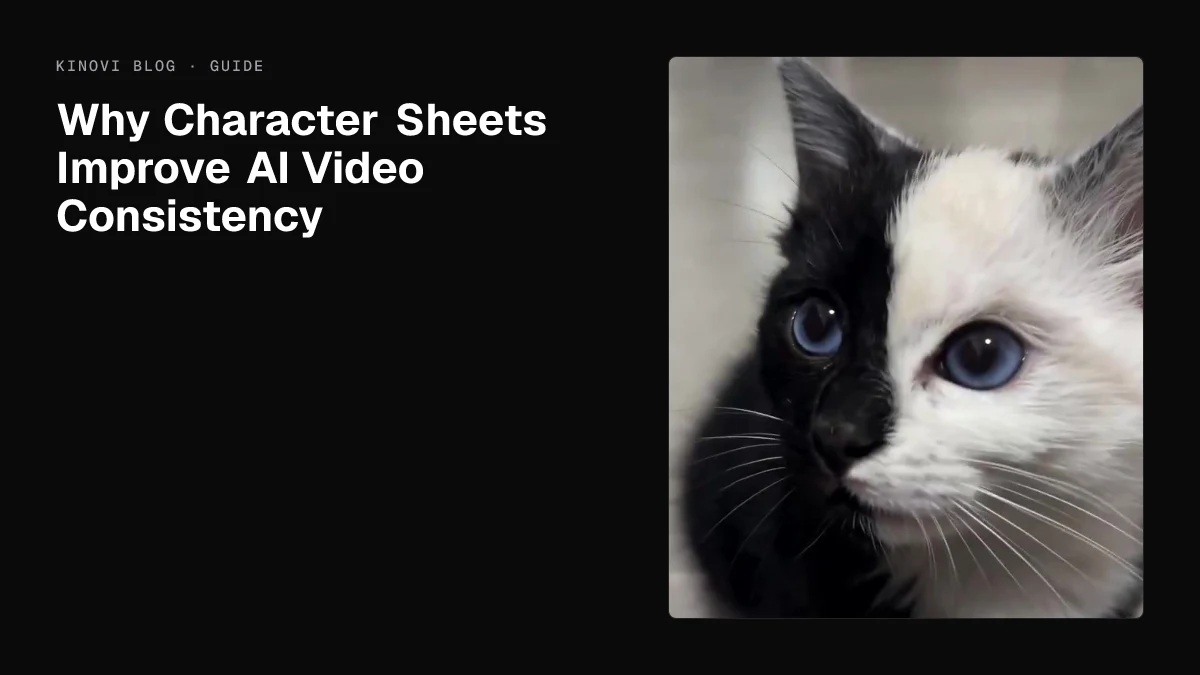
A single reference image tells an AI video model what a character looks like from one angle. It does not fully define the profile, body proportions, clothing silhouette, hairstyle from behind, or how those traits should survive motion.
A character sheet fills in those missing decisions before generation. It does not guarantee perfect consistency, but it gives the model and the production team a far better identity contract.
What one image leaves ambiguous
When the model sees only a front portrait, it has to infer:
- the side profile and jawline;
- body proportions and height;
- the back of the hairstyle;
- wardrobe details hidden by the crop;
- shoes, accessories, and silhouette;
- how the character should look in a wide shot.
Those guesses often appear as drift: a new nose, different age, shorter hair, changed clothing, or a body that no longer belongs to the same person.

What belongs in a useful character sheet
Use a compact set of images with explicit jobs:
| View | What it defines |
|---|---|
| Three-quarter face | Age, facial structure, eye spacing, hairline, makeup |
| Profile | Nose, jaw, ear, and hairstyle silhouette |
| Full body | Proportions, posture, clothing shape, and shoes |
| Back or alternate angle | Hair and garment details hidden by the front view |
| Expression row | The range the character should keep without changing identity |
| Wardrobe detail | Exact material, color, accessory, and logo placement |
Do not fill the sheet with unrelated aesthetics. Every panel should answer a missing identity question.

Separate identity from the scene
Keep the character sheet neutral enough to reuse. A dramatic location, colored light, or extreme lens can become entangled with identity if every reference uses it.
A good packet separates:
identity: face, hair, body proportions
wardrobe: garment, shoes, accessories
environment: location, lighting, color language
motion: gait, gesture, camera rhythm
In the prompt, state each reference role: “Images 1–3 define the character; image 4 defines the coat; image 5 defines the hotel lobby.” This is easier to reproduce than attaching a mood board without priorities.

Test the sheet with deliberate scene changes
Do not test five nearly identical close-ups. Run three scenes that stress different traits:
- a controlled close-up with a head turn;
- a medium action shot in a new environment;
- a wide shot with different lighting and camera distance.
Keep the character packet fixed. Score face, hair, silhouette, wardrobe, motion, and scene continuity from 1–5. If every prompt and reference changes at once, the team cannot learn which part of the packet caused the drift.
Choose a model route that can use the packet
Seedance 2.5 on Kinovi accepts up to 30 images, 10 videos, and 10 audio files with 4–30 second output. It is the first route to test when a recurring character needs multiple identity, wardrobe, scene, and motion references.
Seedance 2.0 supports up to nine images and three videos with 480p through 4K output. It is useful when the accepted character shot needs higher delivery resolution.
The better model does not repair a contradictory character sheet. Resolve conflicts in the packet before spending on final output.
Preserve the character as a production asset
Version the approved sheet and save it beside:
- character name and version;
- source-image IDs or hashes;
- wardrobe variant;
- prompt and reference roles;
- model ID and settings;
- accepted task ID and output;
- review notes about any remaining drift.
Kinovi supports this workflow through Studio and the public task API. It reports 99% API availability, automatically refunds tasks that fail to deliver output, and provides support through a 5,000+ member Discord.
Frequently asked questions
How many images should a character sheet contain?
Use enough views to define the face, profile, body, hair, and wardrobe—often four to eight deliberate panels. More images help only when each adds non-conflicting information.
Should the sheet include multiple outfits?
Keep each wardrobe version separate. Mixing outfits in one identity packet can make clothing less predictable.
Can a character sheet eliminate all drift?
No. It reduces ambiguity and makes review reproducible. Difficult motion, wide shots, interactions, and long sequences can still reveal model limits.
Sources checked
Last checked: September 24, 2026.
Related articles
More to try
Related models

Alibaba · video model
HappyHorse 1.0
HappyHorse 1.0 is Alibaba's high-quality video generation model on Kinovi, supporting text-to-video, image-to-video, reference-image video, and video editing modes.
$0.0801/s

ByteDance · video model
Seedance 2.0
Next-generation AI video model by ByteDance. Combines Fast and Pro modes for high-quality video generation.
$0.0707/s
NanoBanana · image model
NanoBanana 2
Fast, high-quality AI image generation with creative control and photorealistic output.
$0.0707/image